

Choosing the best Automated Conveyors in China depends on the job, not just the catalog. A parcel hub needs speed and routing flexibility. A factory may need steady movement between assembly stations. Food, electronics, and heavy-goods operations also place different demands on belt materials, controls, and safety features.
Technology entrepreneur Bill Gates offered a useful caution: “Automation applied to an efficient operation will magnify the efficiency.” His point applies to conveyors, too. A fast line cannot fix poor layout or badly planned handoffs. It may only move the bottleneck somewhere else. That is easy to overlook.
This guide compares conveyor options by practical criteria: load capacity, throughput, footprint, energy use, control-system compatibility, and maintenance access. It also considers how suppliers handle installation, spare parts, and technical support. Those details matter when a jammed transfer point stops a production shift. Product specifications help, but they do not tell the whole story. Requesting a site assessment or trial can reveal issues that a brochure misses.
There is no universal winner. A modular belt conveyor may suit one facility, while rollers or sorting systems fit another. The comparison is imperfect, because real performance depends on layout and operating conditions. Readers should verify claims with current technical documents and references from similar sites. Small details count. A loud motor, awkward cleaning access, or delayed replacement roller can change the buying decision. This introduction sets up a closer look at what makes a Chinese conveyor solution dependable, efficient, and suitable for a specific operation.
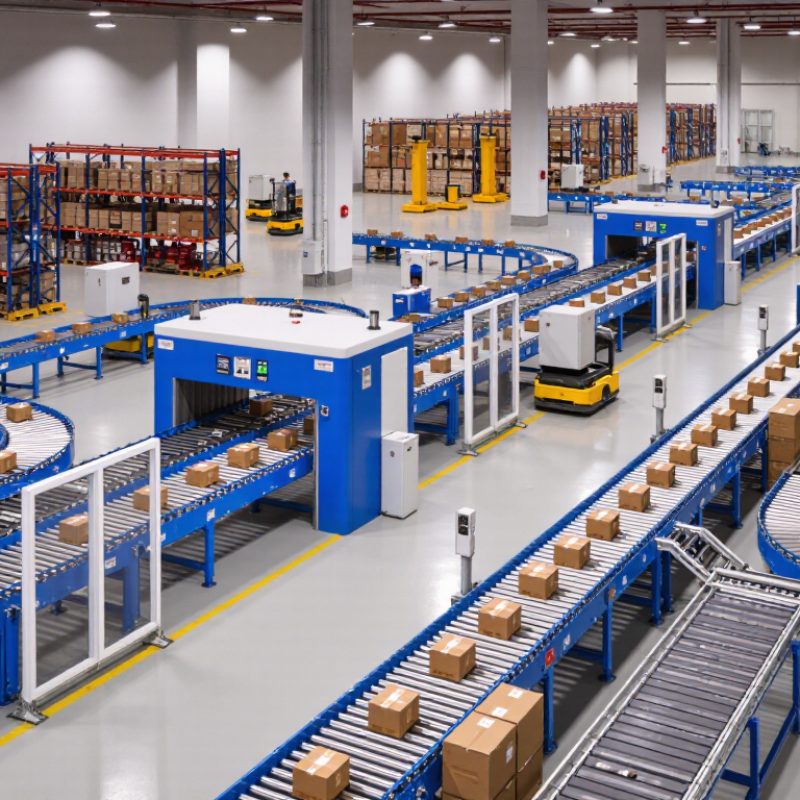
Factories and warehouses in China use different automated conveyor types for different loads. Belt conveyors move cartons, parcels, and packaged goods across long, steady routes. Their smooth surface suits mixed-size products, but belts need regular tracking and cleaning. A slight misalignment can cause cartons to drift.
Roller conveyors handle rigid cartons and totes, especially near packing stations and sortation points. Powered rollers can control spacing, while gravity sections work for short transfers. They are less suitable for soft packages with uneven bases. Small details matter.
For heavier components, chain or slat conveyors can carry pallets and fixtures through assembly areas. Overhead conveyors free floor space and help move suspended parts between workstations. Warehouses with limited floor area may also use vertical lifts to connect levels. Each option has limits. A lift can become a bottleneck if its cycle time does not match upstream flow.
Selection should start with product dimensions, weight, route, and required throughput—not a catalogue label. Measure peak demand, not just an average shift. Leave access for maintenance, and check noise, guarding, and control-system compatibility. A flexible modular line can be easier to change later, though it may cost more upfront. Real layouts rarely stay perfect; even a well-sized conveyor can struggle when order profiles change.

Typical operating-speed ranges for conveyor types used in factories and warehouses
Belt and sortation conveyors can support higher line speeds, while overhead and chain conveyors are commonly used for slower, controlled transport. These are indicative engineering ranges, not China-wide market measurements; actual speeds depend on the load, layout, equipment design, and safety requirements.
Belt conveyors commonly run between 0.5 and 5 m/s, but the right speed depends on the job. At the lower end, cartons are easier to inspect, divert, or load by hand. Faster belts can move more material, provided the feeder and downstream equipment can keep pace. Speed alone does not determine throughput.
Consider a belt moving at 1 m/s with cartons spaced 0.4 metres apart. In theory, it can carry about 2.5 cartons per second. Real output may be lower because of gaps, stops, or uneven feeding. That is only theory. Fragile items, loose products, and awkward transfers often need slower movement to prevent shifting or jams.
Before choosing a speed, check the load, belt width, incline, transfer points, and start-stop pattern. A variable-speed drive can help operators adjust flow during different shifts. Measure the belt under its normal load; an unloaded test may give a misleading result. A neat speed chart is useful, but real lines are rarely that tidy. Reviewing the setting after installation is sensible, even when the original calculation looks convincing.
When comparing automated conveyors in China, rated capacity alone can be misleading. ISO 5048 provides a structured method for calculating belt-conveyor operating power and tensile forces. It connects the material load, belt movement, and resistance the system must overcome.
Capacity depends on the material’s loaded cross-section, belt speed, and bulk density. The cross-section is influenced by belt width, trough shape, and how the material settles. For example, damp mineral granules may form a different load profile from dry grain. Small changes matter. A capacity estimate should use measured material properties, not a catalogue figure alone.
The power calculation considers resistance along the conveyor and the energy needed to raise material. Conveyor length, inclination, idler conditions, and operating details can affect the result. Engineers use the calculation to assess drive requirements and belt tensions, then check those estimates against site measurements. Real systems are imperfect: material flow can surge, and idlers wear. ISO 5048 offers a consistent engineering basis, but assumptions still need review before equipment is selected or adjusted.
China’s GB/T 10595-2017 offers a technical framework for designing belt conveyors. It addresses key system requirements, including conveyor structure, components, performance, testing, and inspection. For buyers, the standard is a practical reference—not a shortcut to choosing equipment. The right design still depends on material type, throughput, route length, and site conditions.
A useful review starts with the belt’s width and speed, then checks loading points, rollers, drive units, and tensioning arrangements. For example, abrasive ore and light packaged goods place very different demands on a belt. The design should account for startup, steady operation, and foreseeable maintenance access. Small details matter. A poorly positioned transfer chute can create spillage, even when the main conveyor is correctly sized.
GB/T 10595-2017 is a recommended national standard, so its role should be checked against project contracts and other applicable requirements. Ask suppliers for design calculations, inspection records, and test evidence that match the proposed operating conditions. Then compare those documents with the installation layout. Paperwork can look complete. It may still leave gaps around dust, temperature, or actual loading patterns. A site-specific review helps reveal those weak points before commissioning.
When comparing automated conveyors in China, look beyond the advertised maximum rate. Ask for sustained throughput using your actual cartons, totes, and shift pattern. Peak rates can mislead. A line moving 3,000 cartons per hour on paper may slow when labels wrinkle, cartons vary in size, or packing stations pause. Request a live trial with representative loads, and measure throughput at the dispatch point, not only at the conveyor’s infeed.
Safety should be checked at transfer points, curves, and areas where workers clear jams. Look for accessible emergency stops, guarded pinch points, and sensors that stop movement when access panels open. Ask how operators can retrieve a fallen parcel without reaching between rollers. Inspect maintenance access, too. A system that is safe during normal operation may still create awkward risks during cleaning or fault recovery. These details deserve an onsite review, not just a checklist.
Integration can decide whether a fast conveyor actually improves the warehouse. Confirm how its controls exchange status and fault messages with warehouse software, and test what happens when the network drops. Request interface documents, alarm examples, and a staged commissioning plan. Compare support for spare parts and response times across the sites you operate. One imperfect detail: projected savings often assume smooth product flow. Build in time to test exceptions, because real orders rarely behave like tidy demonstrations.
The best choice depends on the load, route, and required flow. Throughput figures below are indicative engineering ranges—not guaranteed supplier ratings—and vary with product dimensions, spacing, speed, layout, and operating conditions. Compare proposals using the same load and measurement assumptions.
| Conveyor type | Typical application | Indicative throughput | Safety considerations | Integration considerations | Best fit / trade-off |
|---|---|---|---|---|---|
| Belt conveyor | Cartons, totes, parcels, and some bulk materials; straight runs and gentle inclines. | About 500–3,000 cartons/hour per line in many unit-handling layouts; bulk capacity varies greatly with belt width, speed, and material. | Guard nip and pinch points; provide accessible emergency stops and safe access for belt cleaning and maintenance. | Generally straightforward to connect to photoelectric sensors, VFDs, PLCs, and upstream or downstream control systems. | A versatile option for continuous movement; accumulation and precise singulation may require additional equipment. |
| Powered roller conveyor | Flat-bottom cartons, totes, and pallet loads; transport, buffering, and accumulation. | Often around 500–3,000 cartons/hour on a line; actual rate depends on carton length, spacing, and accumulation-zone logic. | Guard roller nip points and drive components; use suitable zone controls to reduce unwanted contact or product pressure. | Zone controllers and sensors support accumulation; confirm PLC interface, fault reporting, and restart behavior. | Good for buffering and merging compatible loads; unsuitable for soft packages or loads with unstable, uneven bottoms. |
| Chain pallet conveyor | Heavy pallets, fixtures, and rigid loads in manufacturing or warehouse flows. | A layout-dependent range is roughly 300–1,000 pallet moves/hour per line; transfers, stops, and spacing can reduce the sustained rate. | Guard chains, sprockets, and transfer points; assess crush hazards and provide lockout procedures for maintenance. | Requires defined pallet dimensions, orientation, load limits, and handshakes with lifts, turntables, or production equipment. | Robust for heavy, repeatable loads; less flexible when pallet sizes or load bases vary. |
| Parcel sorter (cross-belt or sliding-shoe type) | High-volume parcel or carton routing to multiple destinations. | Commonly designed for several thousand to tens of thousands of parcels/hour; capacity is system-specific and depends on sorter speed, spacing, and destination layout. | Protect moving mechanisms and discharge points; include guarding, emergency stops, safe jam-clearing access, and controlled restart procedures. | Needs reliable item identification, destination logic, exception handling, and tested links to WMS/WCS and scanning equipment. | Best suited to many destinations and high parcel volumes; requires more controls, commissioning, and maintenance than basic conveying. |
| Vertical reciprocating conveyor or lift | Moving cartons, totes, or pallets between floors or mezzanine levels. | Often tens to a few hundred load transfers/hour; lift height, travel time, loading method, and door interlocks determine the actual rate. | Use interlocked landing doors, guarding against access to the shaft, overload protection, and appropriate inspection and maintenance procedures. | Coordinate floor-level calls, occupancy signals, and upstream/downstream accumulation; verify building and fire-safety interfaces as applicable. | Saves floor space and connects levels; typically becomes a flow constraint if demand exceeds its cycle capacity. |
| Overhead conveyor | Hanging garments, painted components, or other loads suited to overhead carriers. | Typically specified in carriers or loads per hour; capacity depends on carrier pitch, chain speed, route length, and process dwell time. | Assess suspended-load and falling-object risks; guard accessible drives and provide safe maintenance access at elevated sections. | Plan carrier identification, workstation controls, route branches, and interfaces with process equipment and production scheduling. | Keeps floor space available; requires suitable building structure and is not appropriate for every load or facility. |

We have over 30 years of experience in designing complete hydraulic systems, repairs and distribution of fluid power equipment and parts.
FOLLOW US ON :
Address:
4020 SE 45th CT.
Ocala, FL 34480
Phone No:
Email:
sales@cunninghamfluidpower.com