

China Best Cantilever Rack Manufacturers and Suppliers

China has a broad market for cantilever storage, from small workshops to high-bay distribution centers. Choosing a supplier takes more than comparing prices. Buyers need to assess load capacity, arm spacing, column strength, finish quality, and the intended goods. A bundle of long steel tubes behaves differently from timber boards or lightweight trim. Details matter.

Warehouse-storage consultant Alex Morgan puts it this way: “A Cantilever Rack is only as dependable as its load plan, connections, and installation.” This is a useful principle, not a substitute for a project-specific engineering review. Ask manufacturers for clear load ratings, drawings, material specifications, and guidance on anchoring. Check whether the quoted capacity applies to each arm or the full upright. That distinction can be easy to miss.

This overview examines China-based manufacturers and suppliers through practical criteria: product range, customization, quality controls, communication, lead times, and after-sales support. It also considers questions buyers can ask before requesting a quotation, such as how the rack will handle uneven loads or future expansion. A polished catalog is not proof of consistent production. Nor is the lowest quote automatically poor value. Supplier claims should be checked against documents and project needs. Some information may remain hard to verify remotely; that deserves honest attention. The goal is a safer, more useful shortlist—not a rushed endorsement.
China Best Cantilever Rack Manufacturers and Suppliers

China Cantilever Rack Manufacturers: 4 Core Components and System Types

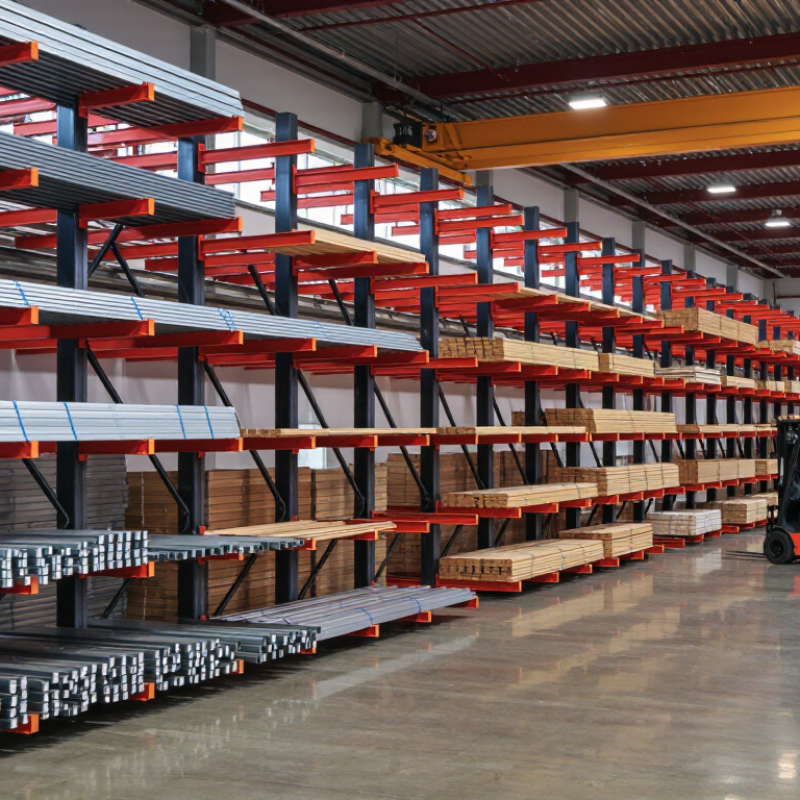
A cantilever rack is built around four parts: uprights, base plates, arms, and bracing. The uprights carry vertical loads, while base plates spread forces across the floor. Arms project outward to support long goods such as timber, pipe, or metal sections. Bracing connects the frames and helps limit sway. Small details matter.

Arm length and spacing should match the stored product, not just the available aisle space. Measure the load’s weight, length, and contact points before selecting a system. Uneven bundles can place more force on one arm than expected. Capacity figures also depend on configuration, so confirm the complete rack layout with a qualified supplier.

System types commonly include single-sided and double-sided racks. Single-sided units fit against walls; double-sided units serve loads from both sides and suit central aisles. Light-, medium-, and heavy-duty versions address different load ranges, but labels alone are not enough. Compare rated capacity, arm adjustment, floor conditions, and handling equipment. A drawing may look clear. On site, access and product overhang can change the plan.

Rack Design and Safety: ANSI MH16.3 and Structural Load Ratings

Cantilever racks look simple, but their arms behave like short beams under uneven loads. ANSI MH16.3-2021 sets design, testing, and use requirements for industrial steel cantilevered storage racks. A supplier should provide capacity ratings for each arm and upright, not just a single “rack capacity.” Ask whether stated ratings assume a specific arm spacing, column height, and load distribution. Small details matter.

The U.S. Bureau of Labor Statistics reported a 4.8 recordable injury and illness rate per 100 full-time workers in warehousing and storage in 2022. That figure is not rack-specific, but it shows why practical safeguards deserve attention. Check that drawings identify the rated load and show how the rack is anchored and braced. On site, inspect for bent arms, loose anchors, and loads extending beyond support points. They are easy to miss. A real installation may also differ from the original plan; that gap deserves a second look before adding capacity. When comparing cantilever rack manufacturers and suppliers, request calculations tied to the actual configuration and written guidance for inspection and load changes.

China Best Cantilever Rack Manufacturers and Suppliers - Rack Design and Safety: ANSI MH16.3 and Structural Load Ratings

Category Design Parameter Example Data or Reference Safety and Rating Notes
Design standard Cantilever rack design and use ANSI MH16.3-2016, Specification for the Design, Testing, and Utilization of Industrial Steel Cantilevered Storage Racks Confirm the edition adopted for the project and any applicable local building-code requirements with the authority having jurisdiction.
Illustrative configuration Single-sided rack bay 4 uprights; 4 arms per upright; 36 in arm length; 48 in upright spacing Example dimensions only; they are not standard-prescribed sizes or a ready-to-build design.
Illustrative component rating Rated load per arm Example assumption: 1,000 lb per arm under the specified loading condition A rating must come from the rack’s engineered design. Confirm whether it applies to a uniformly distributed load or another stated load arrangement.
Illustrative arithmetic Four arms on one upright 4 arms × 1,000 lb per arm = 4,000 lb nominal load on that upright This multiplication is not an approved upright or bay capacity. The upright, base, bracing, connections, anchors, and foundation must also be checked.
Load distribution Product placement along each arm Follow the load arrangement and allowable arm projection stated in the engineered rack documentation. Uneven placement, overhang, or concentrated loads can create greater stresses than the assumed design loading.
Structural stability Uprights, base plates, and bracing Design depends on rack height, arm length, loading, rack arrangement, and required stability checks. Do not remove, relocate, or substitute structural members without review by a qualified rack design professional.
Anchorage and floor Anchor layout and concrete support Anchor type, embedment, spacing, and slab suitability are project-specific. Verify the floor and anchorage against the design reactions and site conditions; do not assume every slab can support every rack configuration.
Load signage Posted rack capacity information Display the applicable rated capacities and loading limitations where operators can readily see them. Use ratings that match the installed configuration and approved design documents; replace inaccurate or missing signs.
Inspection and maintenance Visible damage and altered components Check for impact damage, loose or missing connections, displaced anchors, and unauthorized changes. Remove affected areas from service when damage may compromise safety, and obtain a qualified assessment before returning them to use.
Capacity qualification Final rated load for the installed rack Obtain the rating from project-specific calculations or approved engineering documentation. All example values in this table are illustrative only and must not be used as a substitute for a rack-specific structural design.

Typical Arm Capacity: 250–1,000 kg, Subject to Rack Configuration

Typical cantilever rack arms are rated for about 250–1,000 kg, but that range is not a universal promise. The usable capacity depends on the rack configuration, including arm length, upright spacing, column height, and the number of loaded levels. A short arm holding evenly distributed steel bars faces different forces from a long arm carrying dense panels near its tip.

Numbers need context.

When comparing manufacturers and suppliers in China, ask for the rated capacity per arm and per upright, plus the assumptions behind each figure. Confirm whether ratings apply to uniformly distributed loads, and check the required anchoring and installation conditions. A rack may look substantial, yet appearance cannot confirm its safe working limit.

That matters.

Specify the actual load dimensions, weight, and storage pattern before requesting a design. If bundles are placed unevenly or moved by forklift, those operating details should be reviewed too. Leave a clear safety margin, and verify the final rating on the supplied drawings and load information. Even careful planning can miss a detail; a practical review of the real warehouse layout helps catch it.

Choosing a System: 3 Key Dimensions—Load Length, Arm Depth, and Height

China Best Cantilever Rack Manufacturers and Suppliers

Choosing a System: 3 Key Dimensions—Load Length, Arm Depth, and Height

Start with the actual load, not a rack diagram. Measure each bundle from end to end, including uneven pieces that may overhang. Load length determines how many arms support the material and how much space each bay needs. Arm depth should suit the load’s footprint and center of gravity. Deeper arms are not automatically better; they can make access awkward. Height depends on available clearance, forklift reach, and the vertical space needed between storage levels. Small measurement errors matter.

Tips: Give suppliers the longest and heaviest load dimensions, plus its weight. Ask for a configuration-specific capacity chart. Check floor conditions and required anchoring with a qualified professional.

Compare supplier proposals using the same load details and layout assumptions. Confirm whether stated capacities apply per arm, column, or rack section; these figures are not interchangeable. Ask how the design accounts for uneven loading and future changes in stock. It is easy to focus on maximum capacity and miss daily handling clearance. Recheck measurements on site before ordering. A clear drawing helps, but it cannot correct an inaccurate load description.

Evaluating Suppliers: Welding, Coating, Load Testing, and Traceability

China Best Cantilever Rack Manufacturers and Suppliers

A supplier’s claims matter less than the evidence behind them. Inspect welds on uprights, arms, and base connections. Look for consistent bead size, clean joints, and few visible pores or undercuts. Ask how welders are qualified and how defects are recorded. A neat surface can still conceal a weak connection. Details matter.

Coating quality affects service life, especially in humid warehouses or facilities with frequent handling. Ask how steel is cleaned before coating and how thickness is checked. Request a written inspection record, not just a color sample. Check corners and drilled holes, where thin coverage can be missed. A small scratch on a sample does not prove the whole production run is poor, but it deserves a question.

Load testing should reflect the rack’s stated capacity and intended configuration. Ask for test methods, results, and clear limits for arm spacing and load placement. Ratings can change when components are rearranged. Traceability links each batch to material records, production dates, and inspection results. Confirm that labels or codes remain readable after installation. Paperwork may be incomplete; that is a reason to pause and clarify, not to guess.

Share by: