

Choosing the best Industrial Cutting Machine in 2026 is not simply a contest of cutting speed. The right choice depends on material, thickness, production volume, accuracy, and the cost of downtime. A fiber laser may slice thin stainless-steel sheet cleanly, while a waterjet can handle heat-sensitive materials without a thermal cutting zone. Plasma remains practical for thicker conductive metals. Each option has trade-offs.
The automation context matters. The International Federation of Robotics, in World Robotics 2024, reported 4,281,585 industrial robots operating worldwide in 2023. That figure does not measure cutting-machine sales, but it shows how strongly manufacturers are investing in automated production. Grand View Research’s laser-cutting-machine market analysis also tracks growing demand for precision cutting across manufacturing applications. Those reports offer useful context, not a buying decision. A market forecast cannot tell you whether a machine will suit your shop floor.
Look at real operating details: the size of your largest sheet, the tolerances your parts require, available extraction, operator training, and local service support. Ask suppliers to run your own sample material, not just a polished demonstration piece. Measure edge quality and cycle time, then include consumables and maintenance in the comparison. One point is easy to miss. The fastest machine on paper may not be the most productive in your facility. I should be candid: without your materials and production targets, there is no universal winner. This guide compares the leading machine types and explains which conditions make each one a stronger fit.
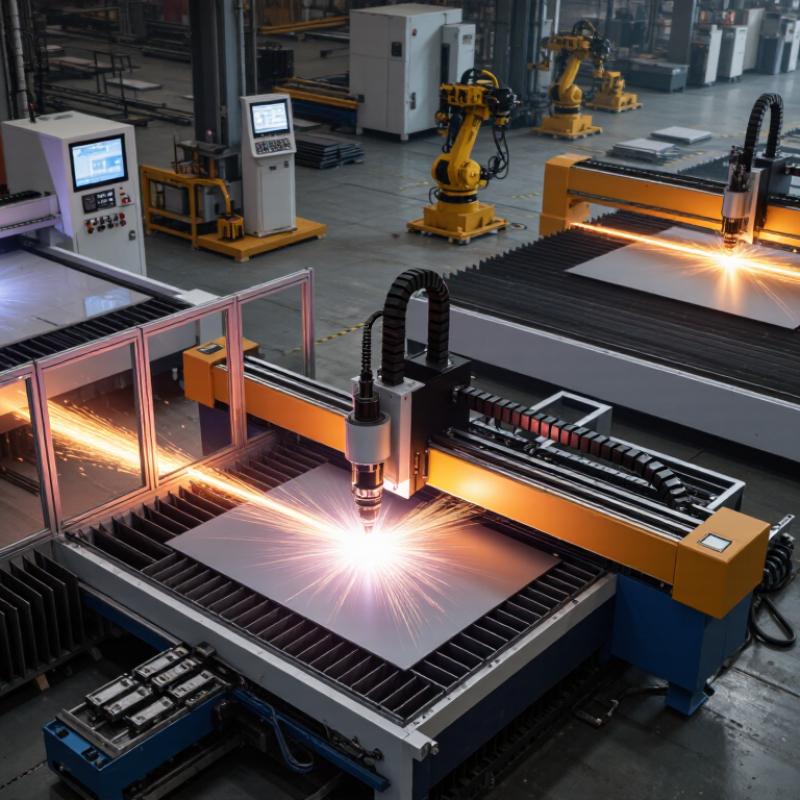
In 2026, an industrial cutting machine is defined by more than its cutting method. It must repeatedly process specified materials at a useful speed, while holding tolerances and managing heat, dust, and scrap. A laser may suit thin sheet; a waterjet can handle heat-sensitive materials. Neither is automatically the better machine. Fit matters more.
The machine’s working envelope, power, software, extraction, guarding, and maintenance access shape its real output. On a busy shift, a clogged filter or awkward nozzle change can matter as much as headline speed. The International Federation of Robotics reported 4,281,585 industrial robots in operation worldwide in 2023, up 10% from 2022, in its World Robotics 2024 report. That growth reflects wider automation, but a cutting cell still needs reliable loading, sensing, and operator oversight. More automation is not always more productive.
Market figures offer context, not a buying formula. Grand View Research estimated the global laser cutting machine market at USD 5.2 billion in 2023 and forecast 7.3% annual growth through 2030. A forecast cannot tell a workshop whether a machine will cut its actual alloy cleanly at the required thickness. Ask for sample cuts, cycle-time data, and repeatability results using your material. Then check the figures against your own production conditions. Even a good test has limits.

Which Is the Best Industrial Cutting Machine in 2026?
How Major Cutting Technologies Differ
The best machine depends on material, thickness, edge quality, and production volume. Fiber lasers focus energy into a narrow beam, producing precise cuts with small kerfs on suitable metals. Plasma systems use an electrical arc and work well on thicker conductive plate, though their edges may need more cleanup. Waterjet cutting uses high-pressure water, often mixed with abrasive, and avoids a heat-affected zone. That matters for heat-sensitive materials.
The market reflects varied demand, not one winning process. Grand View Research estimated the global laser cutting machine market at about USD 5.2 billion in 2023, with projected growth through 2030. MarketsandMarkets projected the waterjet cutting machine market would rise from USD 1.2 billion in 2023 to USD 1.6 billion by 2028. These are market forecasts, not proof that either technology suits every shop.
For a stainless-steel enclosure, laser speed and a clean edge may justify the investment. For thick carbon-steel plate, plasma can be a more practical fit. Waterjet is worth considering when heat distortion is unacceptable, but abrasive use and slower cutting can raise operating costs. Published figures cannot settle the choice. Compare sample cuts, consumables, maintenance, and actual shift patterns before buying; the brochure rarely shows the messy parts.
Which performance factors matter most? The answer depends on your materials, workload, and acceptable finish. A machine that cuts thick plate quickly may struggle with delicate parts or tight tolerances. Compare its rated capacity with the actual materials and thicknesses you process. Ask for a test cut using a representative workpiece. Inspect the edge for burrs, heat marks, and consistency. Look closely. A clean sample matters more than an impressive speed figure.
Throughput matters, but measure it across a full shift, including loading, setup, and changeovers. Check positioning accuracy, repeatability, and how easily operators can adjust cutting parameters. Downtime is expensive. Review routine maintenance needs, consumable costs, energy use, and local service availability. Safety features and clear operating procedures also affect dependable production. One detail is easy to overlook: a faster machine may create extra finishing work. I would question any comparison that ignores that cost. Track real jobs for several weeks; actual results may challenge the assumptions in a specification sheet.
Which Is the Best Industrial Cutting Machine in 2026?
The best industrial cutting machine depends on the material, cut quality, and daily workload. A fiber laser suits precise sheet-metal work, especially when parts have small holes or detailed contours. Plasma cutting is often practical for thicker conductive metals and fast, rougher cuts. Waterjet systems handle many materials without a heat-affected edge, but their abrasive use and operating costs need consideration. Mechanical shears work well for straight cuts in sheet stock. They are less suitable for intricate shapes. There is no universal winner.
Match the machine to the real job, not just its advertised maximum capacity. Check typical material thickness, required tolerances, part size, and production volume. Also consider floor space, ventilation, operator training, maintenance, and how parts will be loaded. A fast cutting head may not improve output if setup takes longer than cutting. Not always. Even a small burr can create extra finishing work, so request sample cuts using your actual material when possible.
Tips: Bring a representative drawing and material sample when comparing machines. Ask how cut quality changes at your usual speed and thickness. Record setup time, consumables, and finishing needs during a trial. Keep the measurements. They may reveal that a less powerful machine fits the work better.
| Machine Type | Best-Matched Applications | Suitable Materials | Typical Cutting Range | Typical Cut Quality / Tolerance | Key Advantages | Main Trade-Offs |
|---|---|---|---|---|---|---|
| Fiber laser cutting | High-volume sheet-metal production; intricate profiles; cabinets, enclosures, and precision components | Carbon steel, stainless steel, aluminum, and other laser-compatible metals | Commonly thin sheet to about 20–25 mm; higher-power systems can cut thicker sections depending on material and required edge quality | Typically about ±0.1–0.3 mm on suitable sheet-metal jobs; varies with thickness, machine condition, and setup | Fast on thin and medium sheet; narrow kerf; readily automated; little mechanical distortion | High equipment and operating costs; reflective materials and thick plate require careful process selection; fume extraction and laser safety are essential |
| CO₂ laser cutting | Non-metal sheet processing and selected metal-cutting work; signs, packaging, textiles, and some fabrication jobs | Acrylic, wood, paper, textiles, and certain metals with an appropriate configuration | Depends strongly on material and laser power; commonly used for non-metals from thin sheets to several centimeters | Fine detail and narrow kerf; achievable tolerance depends on material, thickness, and thermal effects | Versatile for many non-metal materials; good detail on suitable workpieces | Not a universal metal-cutting choice; some materials produce hazardous fumes and require material-specific extraction |
| Plasma cutting | Fabrication shops, structural steel work, repair, and medium-to-thick conductive plate | Electrically conductive metals, including carbon steel, stainless steel, and aluminum | Often used from thin plate to roughly 50 mm; heavier-duty systems can cut thicker material, with edge quality varying by thickness | Typically less precise than laser or waterjet; cut squareness and edge quality decline as thickness increases | Fast and cost-effective for many plate jobs; handles conductive metals and portable job-site work | Creates a heat-affected zone, dross, and fumes; may require edge cleanup; not suitable for non-conductive materials |
| Waterjet cutting | Thick, heat-sensitive, or mixed-material work; aerospace, stone, glass, composites, and precision plate parts | Metals, stone, glass, ceramics, rubber, plastics, and many composites | Commonly handles materials from thin sheet to well over 100 mm, subject to material, nozzle, and quality requirements | Can achieve roughly ±0.1–0.3 mm on precision setups; taper and tolerance depend on thickness, speed, and machine capability | No heat-affected zone; broad material compatibility; suitable for thick sections and heat-sensitive parts | Generally slower than thermal cutting on many metal jobs; abrasive use, water treatment, and maintenance add operating costs |
| Oxy-fuel cutting | Heavy plate work, structural fabrication, shipbuilding, and demolition where thick steel is common | Primarily carbon and low-alloy steels; unsuitable for stainless steel and aluminum in standard oxy-fuel cutting | Most effective on thick steel, often from about 25 mm upward; heavy-duty setups can cut several hundred millimeters | Coarser than laser or waterjet; edge finish and dimensional accuracy usually require more allowance or cleanup | Economical for very thick steel; robust process; suitable for portable and large-format cutting | Slow on thinner plate; substantial heat input and heat-affected zone; requires gas handling and fire-safety controls |
| Mechanical guillotine shear | Straight-line blanking of sheet and plate in repetitive production | Sheet metals such as mild steel, stainless steel, and aluminum, within machine capacity | Typically thin sheet to plate several millimeters thick; heavy-duty machines can handle substantially thicker stock | Clean, straight cuts when properly set; not intended for internal openings or complex contours | Fast, efficient, and economical for repeated straight cuts; no kerf waste along the cut line | Limited to straight cuts; capacity depends on material strength, thickness, blade condition, and machine design |
| Industrial bandsaw | Cutting bars, tubes, pipes, billets, and structural stock to length | Ferrous and non-ferrous metals; some machines also cut plastics and other stock materials | Selected by workpiece cross-section and saw capacity; machines range from small stock-cutting units to large billet saws | Generally suitable for accurate length cutting; finish and squareness depend on blade, feed, and material | Efficient for stock separation; relatively narrow kerf; suitable for bundles and many solid sections | Not suited to intricate sheet profiles; cutting speed and blade life depend on material and operating conditions |
Selection note: There is no single best machine for every job. Cutting ranges and tolerances are indicative industry ranges, not guaranteed specifications; actual performance depends on machine configuration, material grade, thickness, process settings, and quality requirements.
Choosing an industrial cutting machine starts with the material, not the brochure. List the metals, plastics, or composites you actually process, along with their thickness and weekly volume. Then compare cutting methods against edge quality, tolerance, speed, and finishing needs. A machine that cuts quickly may still create burrs or heat distortion that adds costly rework.
Pay attention to the full operating setup. Check floor space, extraction, power requirements, operator training, maintenance access, and local service support. Deloitte and MAPI’s 2024 Smart Manufacturing Survey found that 92% of manufacturers view smart manufacturing as a competitiveness driver over the next three years. That supports considering data connectivity, but it does not make automation the right choice for every shop. Start with a real production sample. Measure cut quality and cycle time, then ask operators to handle routine setup. Small details matter. I would also compare realistic maintenance costs, not just purchase prices; those estimates can be imperfect, and actual wear depends on material and workload. A careful trial may reveal that a simpler machine fits better.
How to choose the best machine for your materials and cutting needs
How to read this chart: Scores are qualitative process-fit ratings, not standardized machine test results: 1 means limited suitability and 5 means strong suitability. Typical capabilities vary with machine configuration, material, and thickness. Laser is often a strong choice for precise sheet profiles; waterjet is versatile for thick or heat-sensitive materials; plasma suits thick conductive plate; bandsaws are well suited to bar and structural stock; and shears excel at straight sheet cuts. Compare material, thickness, geometry, edge-quality requirements, throughput, and total operating cost before choosing.

We have over 30 years of experience in designing complete hydraulic systems, repairs and distribution of fluid power equipment and parts.
FOLLOW US ON :
Address:
4020 SE 45th CT.
Ocala, FL 34480
Phone No:
Email:
sales@cunninghamfluidpower.com