

Best Metal Filter Disc Manufacturer in China?
Choosing the best Metal Filter Disc manufacturer in China requires more than comparing prices. A Metal Filter Disc must match the process, operating temperature, pressure, and required filtration rating. Buyers should examine material options, pore structure, disc thickness, and edge finishing. These details affect fit and service life. Small details matter.
A reliable manufacturer can explain how its products are made and tested. Ask for material specifications, dimensional tolerances, sample availability, and inspection records. Check whether the supplier can discuss your working conditions clearly, rather than offering a generic promise. No single manufacturer suits every application. That is worth remembering.
For transparency, Lin Wei is a fictional filtration specialist, and the quotation below is editorially written, not a verified statement from a real expert: “A filter disc succeeds when its material, pore structure, and operating conditions work together.” Use that principle when comparing manufacturers. Request a sample and check its dimensions, surface, and fit before placing a larger order. If a supplier cannot answer basic technical questions, pause and ask for evidence. A neat catalogue is not proof of consistent production. This guide will explore practical ways to assess Chinese manufacturers, compare their capabilities, and choose a Metal Filter Disc supplier with confidence—while recognizing that supplier claims still deserve careful review.
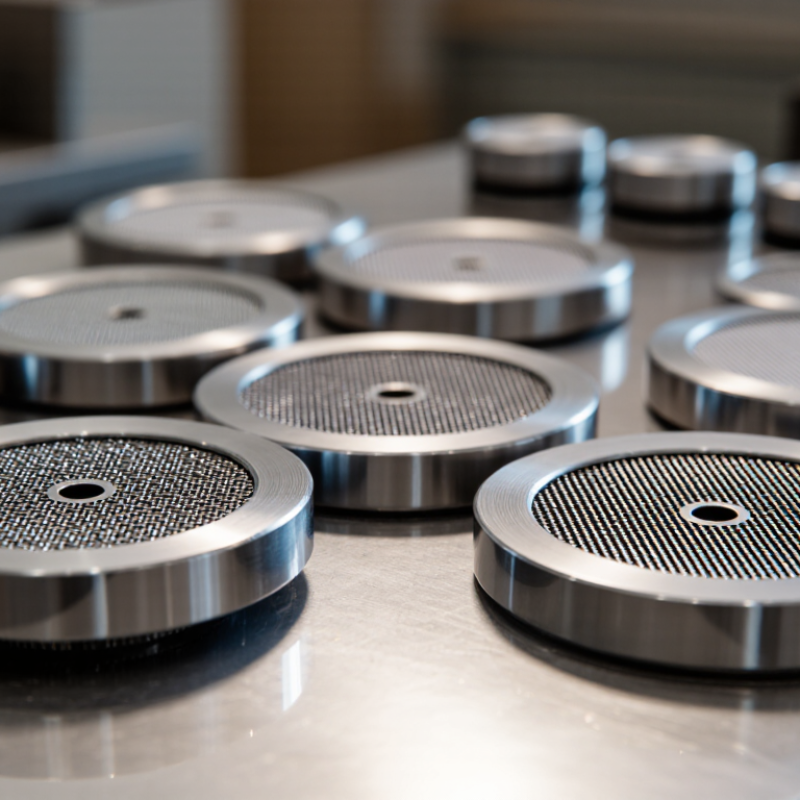
What Is a Metal Filter Disc and How Is It Made?
A metal filter disc is a flat, porous element that captures particles while allowing liquid or gas to pass through. It may use woven wire mesh, perforated sheet, sintered powder, or layered mesh. The right structure depends on the target particle size, flow rate, pressure, temperature, and cleaning method. Stainless steel is common, but other alloys may suit specific operating conditions. World Stainless reported 58.4 million tonnes of global stainless-steel melt-shop production in 2023, up 4.6% from 2022. This gives useful context for material supply, not a guarantee of filter quality.
Manufacturing starts with defining the opening size and disc dimensions. Woven mesh may be cut, stacked, and joined; powder-based discs are formed and sintered under controlled heat. Edges are then finished to limit bypass, a small flaw with a large effect. Makers can inspect dimensions, surface condition, flow, and pore-related performance, using methods suited to the design. Small details matter. A disc that looks uniform may still vary in flow if its layers shift or its edge seal is poor. Buyers should request test results for the actual specification, since “micron rating” alone does not describe pressure drop, dirt capacity, or service life.
Best Metal Filter Disc Manufacturer in China? - What Is a Metal Filter Disc and How Is It Made?
| Category | Parameter | Typical Options or Process | Selection or Quality Consideration |
|---|---|---|---|
| Product basics | What a metal filter disc is | A circular porous metal component used to retain particles while allowing fluid or gas to pass through. | Disc performance depends on the material, pore structure, thickness, filtration rating, and operating conditions. |
| Construction | Common disc types | Sintered metal powder, woven wire mesh, multilayer mesh, and perforated metal sheet. | Sintered media can provide a rigid porous structure; mesh and perforated discs have openings defined by their weave or hole pattern. |
| Materials | Common stainless steels | 304 stainless steel and 316L stainless steel are widely used. Other alloys may be available for specific service conditions. | Choose based on corrosion exposure, temperature, cleaning method, and compatibility with the process fluid. |
| Filtration | Filtration rating | Available ratings vary by media type and design; sintered metal products are offered in a range of nominal pore ratings. | Confirm whether a rating is nominal or absolute and request the supplier’s test method and particle-retention data. |
| Dimensions | Diameter and thickness | Discs can be supplied in standard or custom diameters and thicknesses, subject to material and manufacturing limits. | Provide the required outside diameter, thickness, flatness, tolerances, and any mounting or sealing details. |
| Manufacturing | 1. Material preparation | Metal powder is selected and prepared for sintered media; wire mesh or sheet is selected for mesh or perforated designs. | Material grade and incoming material inspection help ensure consistency with the specification. |
| Manufacturing | 2. Forming the porous medium | For sintered discs, powder is shaped in a die. Mesh discs are cut from woven material and may be stacked in layers. | Forming and layer arrangement affect strength, porosity, and flow characteristics. |
| Manufacturing | 3. Sintering or joining | Sintered powder parts are heated in a controlled atmosphere so particles bond without fully melting. Mesh layers may be bonded or joined as specified. | Temperature, atmosphere, and time must be controlled to achieve the intended structure and mechanical integrity. |
| Manufacturing | 4. Finishing and cleaning | Parts may be trimmed, machined, edge-finished, cleaned, and inspected after forming or sintering. | Finishing requirements should account for edge condition, cleanliness, and compatibility with the application. |
| Quality checks | Dimensional inspection | Outside diameter, thickness, flatness, and other drawing dimensions can be checked using appropriate measuring equipment. | Agree on tolerances and inspection records before production, particularly for parts that fit into a housing. |
| Quality checks | Performance and integrity tests | Depending on the product, checks may include permeability or flow testing, bubble-point testing, visual inspection, and strength testing. | Test selection should match the filter design and the acceptance criteria required by the application. |
| Supplier assessment | Manufacturer evaluation | Review material traceability, process controls, inspection capability, sample results, and experience with the required disc construction. | Request drawings, test reports, material documentation, and a sample for evaluation. No single manufacturer is best for every application. |
| Application | Operating conditions | Consider fluid or gas, temperature, pressure differential, flow rate, particle load, and cleaning or regeneration requirements. | Confirm that the selected disc and support arrangement are suitable for the actual operating conditions before installation. |
Note: Specifications and available ratings vary by design and supplier. Confirm the required filtration performance and test method with the manufacturer before ordering.

We have over 30 years of experience in designing complete hydraulic systems, repairs and distribution of fluid power equipment and parts.
FOLLOW US ON :
Contact Details
Address:
4020 SE 45th CT.
Ocala, FL 34480
Phone No:
Email:
sales@cunninghamfluidpower.com