

How to Choose a Weather Station Humidity Sensor?
Choosing a Weather Station Humidity Sensor is not just a matter of comparing prices or advertised accuracy. Relative humidity readings influence dew-point calculations, frost alerts, greenhouse controls, and local climate records. A sensor that drifts quietly can make a clear morning look damp—or hide the conditions that cause condensation. Small errors matter.
The World Meteorological Organization’s Guide to Instruments and Methods of Observation (WMO-No. 8) emphasizes sound exposure, calibration, and maintenance in reliable weather measurements. NOAA’s climate data guidance likewise underscores the value of consistent observations when comparing conditions over time. These references point to a practical lesson: sensor performance depends on more than the sensing element. Shield design, airflow, response time, operating range, and calibration access all affect the reading you get outdoors. A precise laboratory specification may not predict performance beside a sunlit wall or in a poorly ventilated radiation shield.
There is no perfect choice. Start with the station’s purpose, local climate, and required accuracy, then check whether the manufacturer explains testing and calibration methods. Compare stated accuracy across the humidity range, not just at one comfortable room condition. Also consider replacement parts and long-term drift. A low-cost sensor may be sufficient for garden monitoring; it may be less suitable for research or operational records. The distinction is easy to overlook. A specification sheet can look reassuring, yet leave important questions unanswered. This guide examines those trade-offs and offers a practical way to choose with clearer expectations.
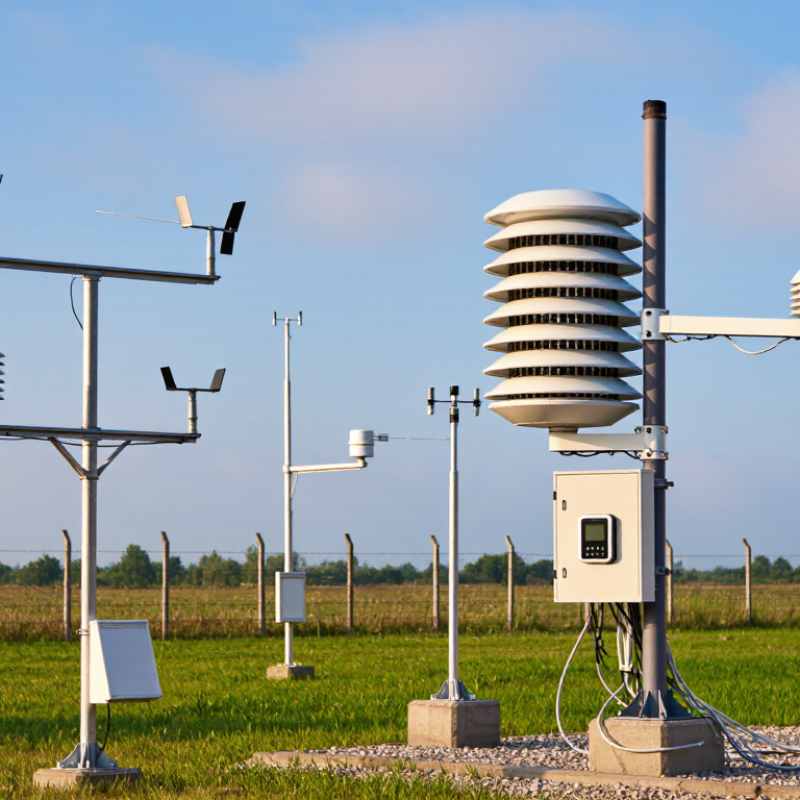
Understand the Role of Humidity Sensors in Weather Stations
A humidity sensor measures water vapor in the air, usually as relative humidity. In a weather station, that reading helps explain whether the air is drying, clouds may form, or morning fog is likely. Paired with air temperature, humidity also supports dew-point calculations and makes local conditions easier to interpret. The World Meteorological Organization’s Guide to Instruments and Methods of Observation specifies a 3-percentage-point uncertainty target for routine relative-humidity measurements. That is a useful benchmark when comparing sensor specifications.
The value reaches beyond a dashboard. FAO Irrigation and Drainage Paper 56 uses humidity alongside temperature, radiation, and wind speed to estimate reference evapotranspiration. Farmers and water managers can use such estimates to plan irrigation. For dependable readings, place the sensor in a ventilated radiation shield, away from walls, roofs, and sprinklers. A sun-warmed enclosure can report air that is drier than the surrounding environment. Small errors add up.
When choosing a sensor, check its stated accuracy across the temperatures your site experiences, not just at room temperature. Also consider response time, calibration needs, and protection from condensation. A sensor may look precise on paper, yet drift after months outdoors. That is worth checking. Keep a simple maintenance log, compare readings with a trusted reference periodically, and note any sudden changes after storms or cleaning.
How to Choose a Weather Station Humidity Sensor? - Understand the Role of Humidity Sensors in Weather Stations
| Sensor type | How it works | Typical strengths | Limitations | Best suited to |
|---|---|---|---|---|
| Capacitive polymer | A moisture-sensitive polymer changes its capacitance as it absorbs or releases water vapor. | Compact, low power, and suitable for continuous digital readings; widely used in electronic weather stations. | Readings can drift with age or contamination; accuracy and operating limits vary by model. | Most home, school, and general-purpose outdoor stations. |
| Resistive | Water absorbed by a sensing material changes its electrical resistance. | Can be inexpensive and compact; suitable for basic humidity monitoring. | Performance may be affected by temperature, contamination, and long-term aging; check the stated accuracy carefully. | Budget applications where moderate precision is acceptable. |
| Chilled mirror | A mirror is cooled until condensation forms; the measured temperature at that point indicates the dew point. | Direct dew-point measurement can provide high accuracy and serve as a reference for calibration. | Typically more costly, larger, and more maintenance-intensive than electronic polymer sensors. | Reference measurements, laboratory work, and demanding monitoring applications. |
| Psychrometer | Wet-bulb and dry-bulb temperatures are compared to determine humidity using psychrometric relationships. | A well-established measurement method; useful when maintained and operated correctly. | Requires airflow, a clean wet wick, and regular water supply; less convenient for unattended stations. | Manual observations and some professional monitoring setups. |
Key selection criteria
| What to check | Why it matters | Practical guidance |
|---|---|---|
| Relative-humidity range | The sensor must cover the conditions expected at the station, including very dry air and near-saturation conditions. | Look for a specified range that includes 0–100% RH if full-range outdoor monitoring is needed. |
| Accuracy and calibration | Accuracy indicates how close a reading is to the actual value; calibration helps confirm or restore measurement performance. | Compare the accuracy specification at the relevant humidity and temperature. Confirm whether calibration or sensor replacement is available. |
| Temperature compensation | Humidity-sensor readings can depend on temperature, so compensation supports reliable measurements across changing weather. | Choose a sensor with a stated operating-temperature range appropriate for the local climate. |
| Weather protection and airflow | Direct rain, solar heating, condensation, and poor ventilation can distort readings or damage the sensor. | Use a ventilated radiation shield or suitable sensor housing, and follow the station's installation guidance. |
| Response time and logging interval | A sensor's response time affects how quickly it reflects changing conditions; recording more often does not make a slow sensor respond faster. | Match response time and sampling interval to the monitoring purpose, such as general daily trends or rapid weather changes. |
| Output and compatibility | The sensor must communicate with the station logger or data system. | Check the required interface, supply voltage, connector, and data format before purchase. |
| Maintenance and service life | Dust, salt, pollutants, and prolonged exposure to condensation can affect sensor performance over time. | Review cleaning instructions, recommended inspection intervals, and replacement or recalibration options. |
Specifications differ between sensor models and operating conditions. Use the manufacturer's published data sheet for exact accuracy, range, response time, and environmental limits.

We have over 30 years of experience in designing complete hydraulic systems, repairs and distribution of fluid power equipment and parts.
FOLLOW US ON :
Contact Details
Address:
4020 SE 45th CT.
Ocala, FL 34480
Phone No:
Email:
sales@cunninghamfluidpower.com