

Why Choose FEP or PTFE for Industrial Applications?

Why Choose FEP or PTFE for Industrial Applications?

Fep Ptfe selection is not a contest for one universally superior material. It is a decision about temperature, chemical exposure, fabrication, and inspection. A pump seal facing hot chemicals has different needs from clear tubing that must be formed into a complex route. Small differences matter.

Chemours’ technical data sheets report typical melting points near 327°C for PTFE and 260°C for FEP; actual values depend on grade and test method. Its product literature also distinguishes PTFE’s high-temperature capability and low friction from FEP’s melt-processability and transparency. These are useful starting points, not design guarantees. Pressure, cycling, wall thickness, and installation can change performance. ASTM specifications, including D4894 for PTFE molding and extrusion materials and D2116 for FEP, provide additional material benchmarks.

Polymer author John Scheirs’ book Modern Fluoropolymers offers a useful selection principle, paraphrased here: “Match the fluoropolymer to the service conditions, not just its name.” That distinction is easy to overlook. PTFE often suits demanding thermal or sliding applications, while FEP can simplify fabrication where melt processing or visual inspection matters. Neither choice removes the need to check grade-specific data and operating limits. A datasheet is not a field trial. Before specifying either resin, compare the supplier’s technical report with the actual chemical, temperature, and mechanical conditions. Then test the design where failure would be costly.
Why Choose FEP or PTFE for Industrial Applications?

Understanding FEP and PTFE as Industrial Fluoropolymers

FEP and PTFE are fluoropolymers, but their processing and performance differ. PTFE resists heat and chemical attack, yet it does not flow like ordinary thermoplastics when melted. FEP can be melt-processed, making it practical for continuous tubing and uniform coatings. It is also transparent. A useful distinction.

Technical property tables in the Fluoroplastics reference series place typical continuous-use limits near 260°C for PTFE and 200°C for FEP. These are not guarantees: load, exposure time, and test conditions matter. ASTM D4894 covers granular PTFE molding and extrusion materials; ASTM D2116 covers FEP materials. Such standards help buyers compare specifications, but they do not replace testing in the actual operating environment.

In service, PTFE can suit seals or sliding components exposed to heat and aggressive chemicals. FEP tubing can make fluid movement visible, while its melt processability supports consistent dimensions. The trade-off is real. FEP’s lower temperature ceiling may rule it out near a hot process line, while PTFE’s processing demands can complicate part design. Check pressure, temperature cycling, chemical contact, and installation bends before selecting either material. Small details matter.

Key Properties That Support Industrial Performance

Industrial parts face several stresses at once: hot fluids, abrasion, pressure, and frequent cleaning. FEP and PTFE are valued for broad chemical resistance, low surface friction, and electrical insulation. These properties can help limit deposits inside transfer tubing and protect cables in demanding environments. Small details matter. Temperature, chemical concentration, pressure, and exposure time can affect performance, even when the polymer name stays the same.

PTFE suits applications prioritizing high heat tolerance and low friction, including gaskets, valve seats, and sliding parts. FEP can be useful for melt-processable tubing or transparent coatings. Neither is universal. Designers should check published grade limits and test the actual fluid, temperature cycle, and mechanical load. In plant trials, a small bend or tight clamp can become the weak point. Worth checking again.

How FEP and PTFE Differ in Practical Use

Why Choose FEP or PTFE for Industrial Applications?
How FEP and PTFE Differ in Practical Use

In practical use, the right fluoropolymer depends on temperature, part shape, and installation needs. PTFE suits demanding heat exposure and sliding contact, such as seals or liners where low friction matters. It resists many chemicals, but it can be difficult to melt-process into intricate shapes. FEP is melt-processable, so manufacturers can form it into tubing, films, and coated components. Its clarity can also help when a process needs visible fluid flow. FEP generally has a lower service-temperature ceiling than PTFE, though exact limits depend on grade and system design.

These differences show up on the factory floor. A PTFE liner may handle a hot, abrasive process well, yet require careful machining and support. FEP tubing can be easier to fabricate and inspect, but may not suit the same sustained heat. I would not choose from a comparison chart alone. Real fittings, pressure, cleaning cycles, and movement can change performance. Even a small bend radius can matter.

Tips: Check the material datasheet against actual operating temperatures, chemicals, and pressure. Test a sample in the real assembly when possible. A quick test may reveal a detail the specification misses.

Why Choose FEP or PTFE for Industrial Applications? — How FEP and PTFE Differ in Practical Use

Practical consideration PTFE FEP What this means in practice
Typical continuous-use temperature Up to approximately 260°C (500°F), depending on grade and application. Up to approximately 200°C (392°F), depending on grade and application. PTFE is generally preferred when sustained high-temperature performance is the priority.
Melting temperature Approximately 327°C (621°F). Approximately 260°C (500°F). These are melting temperatures, not recommended continuous operating temperatures.
Processing and fabrication Not conventionally melt-processable; commonly shaped by methods such as paste extrusion, compression molding, or ram extrusion. Melt-processable by conventional thermoplastic methods, including extrusion and injection molding. FEP can be a practical choice for seamless tubing, films, and complex molded shapes. PTFE often requires specialized processing.
Transparency Typically opaque or translucent, depending on form and thickness. Can be optically clear in suitable thin sections. FEP is useful when visual inspection through tubing or film is desirable.
Chemical resistance Broad resistance to many chemicals, including many corrosive substances. Broad resistance to many chemicals, similar to PTFE for numerous applications. Compatibility depends on the specific chemical, temperature, concentration, and exposure conditions; verify before use.
Friction and release Known for very low friction and strong non-stick characteristics. Also offers low friction and non-stick behavior, though PTFE is often selected when minimizing friction is especially important. PTFE is commonly considered for sliding surfaces, seals, and low-friction components.
Electrical properties Excellent electrical insulation; relative permittivity is typically about 2.1 at 1 MHz. Excellent electrical insulation; relative permittivity is typically about 2.0–2.1 at 1 MHz. Both are widely used for wire and cable insulation. Actual performance depends on grade, frequency, temperature, and test method.
Typical industrial uses High-temperature seals, bearings, liners, gaskets, chemical-processing components, and electrical insulation. Clear chemical-transfer tubing, wire and cable insulation, films, linings, and molded components. Choose based on operating temperature, fabrication method, transparency needs, mechanical demands, and chemical exposure.

Note: Figures are typical reference values, not guaranteed design limits. Properties vary by grade, product form, test method, and operating conditions. Confirm suitability with current material data and application-specific testing.

Choosing Between FEP and PTFE for Operating Conditions

Operating conditions should guide the choice between FEP and PTFE. Both resist many corrosive chemicals, but temperature, pressure, movement, and fabrication needs can shift the decision. PTFE commonly supports continuous use near 260°C, while FEP is often rated around 200°C. Actual limits depend on the grade and the application. Check the data sheet.

FEP can be melt-processed, making it useful for tubing with smooth, clear walls. That visibility helps technicians spot trapped air or residue during inspection. It also tends to be more flexible than PTFE in comparable forms. PTFE is often preferred where higher heat tolerance, low friction, or strong chemical resistance matters. Under sustained load, however, PTFE can deform over time. That detail is easy to miss.

Think about the equipment in use, not just the fluid. A line that bends around a tight frame may benefit from FEP’s flexibility. A hot seal or sliding component may call for PTFE, depending on pressure and wear. Neither material is automatically right. I would also check startup temperatures, cleaning cycles, and exposure duration; real operating conditions rarely stay perfectly steady. A small mismatch can become a leak or an early replacement.

Why Choose FEP or PTFE for Industrial Applications?

Choosing Between FEP and PTFE for Operating Conditions

PTFE typically supports higher continuous service temperatures, while FEP is commonly used where melt-processability and transparency are useful. These figures are typical limits, not guarantees; actual performance depends on material grade, load, exposure, and application conditions.

Common Industrial Applications of FEP and PTFE

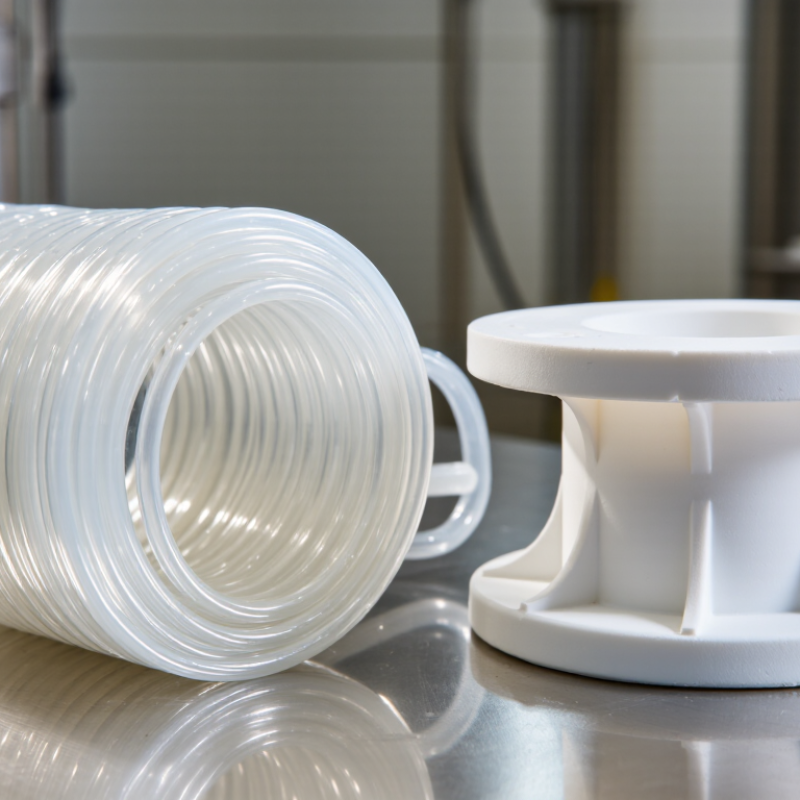
FEP is often selected for chemical transfer tubing, laboratory lines, and wire insulation where flexibility and visibility are useful. Its melt-processability allows tubing and complex shapes to be manufactured consistently. A clear FEP tube can make fluid movement and trapped bubbles easier to inspect. It is also used as a lining or release film when surfaces need to resist many chemicals. Its temperature limits are generally lower than PTFE’s, so operating conditions matter.

PTFE commonly appears in pump seals, gaskets, valve seats, bearings, and equipment linings. Its low friction helps moving parts slide, while its chemical resistance suits demanding process environments. Small details matter. A seal may fail because of compression, movement, or poor installation before the polymer itself reaches its limit. Engineers should check temperature, pressure, chemical exposure, and mechanical load together. In practice, the best material is not always obvious; a fitting, joint, or cleaning cycle can change how the component performs. Testing the actual assembly can reveal issues that a material data sheet cannot.

Article Source:

Share by: