
How to Choose a Hydraulic Piston Pump?

Choosing a Hydraulic Piston Pump is not simply a matter of comparing displacement, pressure, and price. The correct choice depends on the complete circuit, including duty cycle, fluid cleanliness, temperature, control method, and installation conditions. A pump that performs well on a test bench may fail early beside a steel press, excavator boom, or injection-molding machine.

Industry forecasts show why this decision deserves careful attention. MarketsandMarkets reports continued growth in the global hydraulic pumps market, supported by construction, agriculture, and industrial automation. Grand View Research also identifies energy efficiency and variable-displacement technology as major market drivers. These figures indicate demand, not guaranteed performance. They should guide investigation rather than replace it.

A reliable selection process starts with measurable requirements. Record flow demand at operating speed, peak and continuous pressure, reservoir temperature, oil viscosity, and expected operating hours. Then compare axial or radial piston designs, open- or closed-circuit compatibility, displacement control, noise levels, and service access. ISO 4413 provides important guidance for hydraulic system safety, while ISO 4409 addresses positive-displacement pump testing and performance verification. Manufacturer curves remain essential, but their test conditions must match the real application.

Small details matter. A contaminated oil sample, undersized suction line, or poorly aligned coupling can erase the benefits of an expensive pump. I have seen specifications focus heavily on maximum pressure while ignoring minimum inlet pressure. That is a costly blind spot. No single pump fits every machine. The best choice balances efficiency, durability, controllability, maintenance support, and verified operating data. Some published market numbers also vary by research method, so critical decisions should be checked against field measurements and supplier documentation.
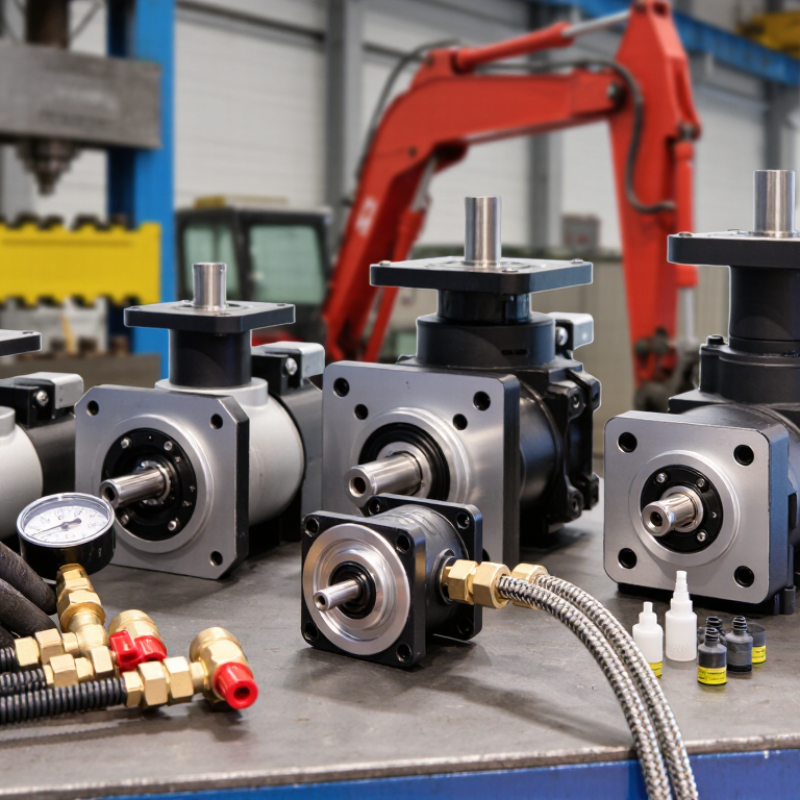
How to Choose a Hydraulic Piston Pump?

Identify Application Flow, Pressure, Speed, and Duty-Cycle Requirements

How to Choose a Hydraulic Piston Pump?

Start with the application, not the pump catalog. Define required flow, pressure, speed, and duty cycle. Flow depends on actuator speed and cylinder size.

For example, a 100 mm cylinder moving at 0.5 m/s needs about 24 L/min. Add realistic leakage allowance, but avoid excessive oversizing.

Pressure should reflect the highest working load, plus short-term peaks. A pressure gauge at the actuator can reveal surprises that calculations miss.

Speed requires equal attention. A pump running at 1,800 rpm may perform well, yet struggle at 600 rpm. Check minimum speed, maximum speed, inlet pressure, and suction-line losses.

Duty cycle describes how hard the pump works. Continuous operation demands stable heat rejection and strong volumetric efficiency. Intermittent operation may tolerate higher peaks. The U.S. Department of Energy reports that motor-driven systems consume roughly 60% of industrial electricity, so inefficient speed control can become an expensive hidden load. This figure is broad, not hydraulic-specific, but it deserves consideration.

Tips: Record actual pressure and flow during a full work cycle. Compare loaded and unloaded readings. Use ISO 4406 cleanliness codes, which count particles at 4, 6, and 14 micrometres. Clean oil matters. It is easy to blame the pump when contamination, aeration, or poor alignment causes the real problem. A neat spreadsheet can still mislead; field measurements should challenge it.

Choose Axial or Radial Piston Design for Pressures up to 700 bar

How to Choose a Hydraulic Piston Pump?

Choose Axial or Radial Piston Design for Pressures up to 700 bar

Choosing between axial and radial piston designs starts with the real pressure cycle, not the maximum number on a brochure. At pressures approaching 700 bar, confirm continuous, peak, and shock pressure ratings separately. An axial piston pump usually offers high power density, adjustable displacement, and efficient flow control. It suits mobile equipment, test systems, and machines requiring frequent output changes. Keep the oil clean.

A radial piston pump can be a stronger choice for very high pressure, low-speed operation, and repeated loading. Its piston arrangement handles substantial force through a compact working chamber. It often performs well in presses, clamping circuits, and injection equipment. Its slower operating range may reduce flexibility, however. Not always.

For either design, compare required flow, motor speed, control response, noise, heat generation, and service access. A pump rated for 700 bar may still fail when exposed to pressure spikes, poor filtration, or an unsuitable fluid. A common field mistake is selecting pressure first and checking flow later. That reverses the practical decision. I would also inspect duty-cycle data, relief-valve settings, shaft loading, and mounting alignment. Leave margin for wear. During commissioning, record pressure, temperature, and case-drain flow under load; these details often reveal problems before performance drops. The final choice should follow measured operating conditions, verified test data, and the consequences of one unexpected pressure surge.

Match Displacement Using Q = nVηv and Required Flow in L/min

How to Choose a Hydraulic Piston Pump?

Start with the required flow, not the pump catalog. A machine may need 75 L/min during cylinder extension. The pump must deliver that flow at the working speed.

Use Q = nVηv, then convert units carefully.

Here, Q is actual flow in L/min, n is speed in revolutions per minute, and V is displacement in cm³/revolution. The factor 1,000 converts cubic centimeters into liters.

If speed is 1,500 rpm and volumetric efficiency is 0.92, the required displacement is:

V = 75 × 1,000 ÷ (1,500 × 0.92)

That equals about 54.3 cm³/rev. Check the arithmetic twice. Small unit errors create large selection mistakes.

Real machines rarely operate under perfect conditions. Oil temperature, leakage, inlet restrictions, and aging seals can reduce volumetric efficiency. Measure flow with a calibrated flow meter when possible. A pressure gauge also helps reveal whether the pump reaches its rated conditions.

Do not add a large displacement margin without checking motor power and maximum pressure. Oversizing can increase heat, noise, and energy use.

Dynamic systems need special attention. A press, for example, may require high flow during approach but much less flow during forceful pressing.

In that case, calculate each operating stage separately. A simple average can mislead. Recheck the result at the lowest expected speed, because the pump may fail to meet flow demand there.

Verify Efficiency, Power, and Operating Temperature: 85–95% Typical

How to Choose a Hydraulic Piston Pump?

A hydraulic piston pump should be selected from measured efficiency, not pressure rating alone. Total efficiency commonly falls between 85% and 95% at a stable design point. ISO 4409 provides test methods for displacement pumps, including flow, torque, and efficiency measurements. Ask for test results at your actual pressure, speed, and fluid viscosity. A catalog value may represent ideal laboratory conditions.

Calculate hydraulic power before choosing the motor. Use P = Δp × Q ÷ 600, with pressure in bar and flow in litres per minute. At 250 bar and 80 L/min, the hydraulic output is about 33.3 kW.

At 90% efficiency, input demand approaches 37 kW. That difference becomes heat. It also affects cable sizing, motor capacity, and running cost. Small errors matter.

Temperature deserves equal attention. Many industrial systems operate near 40–60°C, but the permitted range depends on fluid type, seals, contamination, and duty cycle. ISO 4406 cleanliness guidance helps control particle-related wear, while ISO 4409 supports repeatable performance checks. Measure the reservoir and case-drain temperatures during a full-load cycle. A brief test can hide thermal drift.

I have seen a pump appear efficient cold, then lose performance after an hour. That result deserves investigation, not excuses. Choose the pump only after comparing efficiency, power demand, and temperature rise under realistic conditions.

Specify ISO 4406 Fluid Cleanliness and Confirm Control-System Compatibility

How to Choose a Hydraulic Piston Pump?

A piston pump should match the machine’s pressure, flow, duty cycle, and control method. However, fluid cleanliness often decides whether that performance lasts. Specify the required ISO 4406 cleanliness code before selecting the pump. A code such as 18/16/13 describes particle levels above 4, 6, and 14 microns. Lower numbers mean cleaner oil. Confirm the code with a laboratory sample, not a visual inspection. Clear oil can still contain damaging particles.

Control-system compatibility also needs careful checking. Compare the pump’s control type with the machine’s command signal, feedback method, and safety logic. Check voltage, current, pressure limits, response time, and connector wiring. A pump may accept an electronic command but respond poorly to an unstable signal. During commissioning, monitor pressure ripple, temperature, displacement, and response under changing loads. Small mismatches become obvious near maximum pressure.

Tips: Take samples from a live, warm circuit using clean equipment. Record the ISO 4406 result, oil temperature, filter condition, and sampling date. Ask the supplier for control curves and fail-safe behavior. I once focused too heavily on rated pressure and overlooked signal delay. The system worked, but its motion felt hesitant. That mistake changed my selection checklist. Do not assume a cleaner filter alone solves contamination; reservoirs, hoses, and maintenance practices can reintroduce particles. Still, cleanliness targets may need adjustment after real operating data. Test, document, and review.

Share by: