

Vacuum Furnace Heat Treatment plays a critical role in producing clean, consistent, and dimensionally stable metal components. The right furnace can influence hardness, strength, surface condition, and production reliability. Yet choosing one is rarely a simple equipment comparison. Chamber size matters. So does alloy type.
A suitable system must match the workload, part geometry, temperature range, and cooling requirements. A thin aerospace component may need different control than a heavy tool-steel die. Temperature uniformity also deserves careful attention, especially around dense loads and difficult corners. Ask for documented test results, not only attractive specifications. Review calibration records, thermocouple placement, vacuum performance, and maintenance procedures. Small details matter.
This guide presents seven practical tips for evaluating a vacuum furnace with greater confidence. It considers process control, loading flexibility, quenching capability, energy use, service support, and long-term operating costs. Experienced engineers often inspect the furnace interior, seals, pumps, and control interface before discussing price. That practical step can reveal weaknesses hidden in a sales brochure. It is also wise to compare actual production data with promised performance. No selection process is flawless. Initial assumptions may prove incomplete after the first trial load. Careful testing and honest review remain essential. A reliable decision should combine supplier expertise, verified evidence, and the specific demands of your heat-treatment operation.
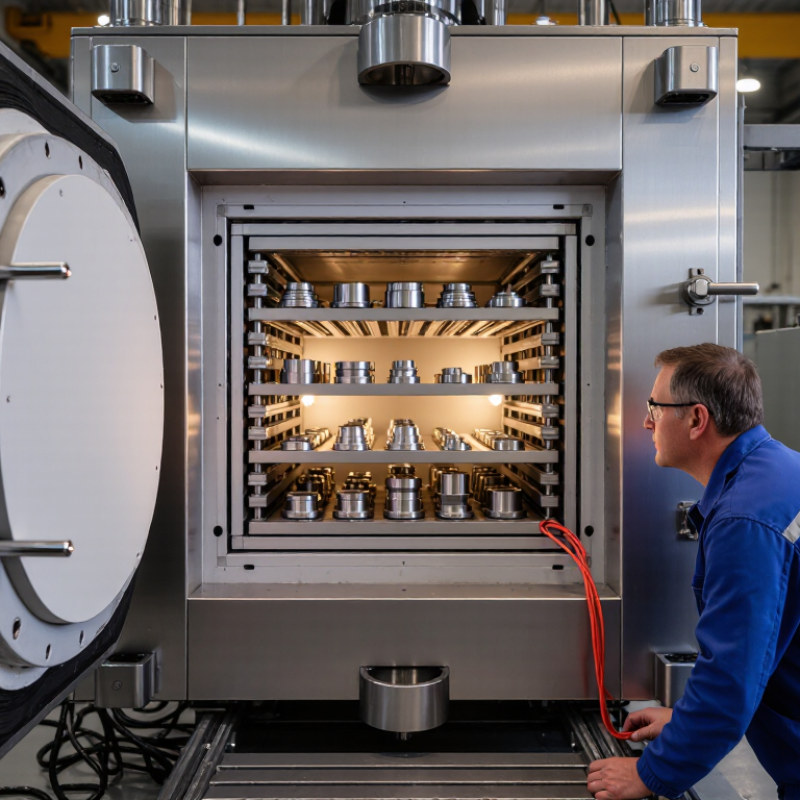
Tip 1: Define the material before selecting a vacuum furnace cycle. Identify its alloy family, previous processing, hardness, and sensitivity to oxidation. Tool steel, titanium, and nickel alloys require different heating rates, vacuum levels, and cooling methods. Review the material specification and consult a qualified metallurgist when data is incomplete. Small assumptions can cause large distortions.
Tip 2: Study the part geometry in three dimensions. Thin edges may heat faster than thick hubs, while deep holes can trap contaminants or restrict gas flow. I have seen apparently simple parts warp because fixtures supported them unevenly. Use clean, stable supports and leave enough space between components. Load size matters too. A crowded chamber may cool parts inconsistently.
Tip 3: Connect the treatment to a measurable goal. The target may involve hardness, wear resistance, dimensional stability, or a specific microstructure. Set acceptable limits before production begins. Record temperature uniformity, pressure, cooling rate, and final inspection results. A polished procedure is not automatically a reliable one. Test a representative sample first, then compare hardness maps and critical dimensions. If results differ, question the cycle, the loading pattern, and the measurement method—not only the furnace.

Define the material, part geometry, and treatment goals before selecting furnace temperature, vacuum level, loading method, and cooling capability.
The chart shows representative target temperatures commonly used for selected vacuum heat-treatment applications. Actual settings depend on the specific alloy, grade, section thickness, required hardness, atmosphere control, and applicable material specification.
7 Tips for Choosing Vacuum Furnace Heat Treatment
Compare Furnace Temperature Range, Vacuum Level, and Atmosphere Control
A suitable vacuum furnace must match the alloy, part size, and required heat-treatment cycle. A wider temperature range is not automatically better. Check uniformity across the working zone, not only the highest rated temperature. For many components, a stable temperature within a few degrees matters more than an impressive maximum. Ask for calibration records and independent temperature surveys. Small differences can change hardness, grain structure, or distortion.
Vacuum level deserves careful comparison. The ultimate vacuum shows system capability, but it may not represent production performance. Review achievable pressure under a heated load. Examine pump-down time, leak-rate testing, and pressure stability during the cycle. A clean chamber with low outgassing supports more consistent results. Still, numbers can mislead. A furnace reaching very low pressure slowly may perform worse than a faster, stable system.
Atmosphere control completes the comparison. Confirm whether the furnace supports inert gas backfilling, partial-pressure operation, and controlled cooling. Gas purity, flow rate, and pressure accuracy affect oxidation, surface condition, and cooling speed. Test the control response with a representative load. An empty-chamber test is useful, but incomplete. The real workload may release moisture or trapped oil. That detail is easy to overlook. Keep cycle records, thermocouple data, and alarm history for every qualification run. A careful review may reveal that the chosen specifications do not fit the actual parts.
| Tip | Selection Dimension | Typical Technical Range or Target | Why It Matters | What to Verify Before Purchase |
|---|---|---|---|---|
| 1 | Match the Furnace Temperature Range to the Material | Common vacuum furnaces: approximately 1,000–1,350°C; high-temperature models may reach about 2,000°C or higher. | The maximum operating temperature must exceed the required treatment temperature while maintaining uniformity and component integrity. | Confirm rated temperature, continuous operating temperature, heating-element material, usable work-zone size, and temperature uniformity at the intended setpoint. |
| 2 | Choose the Required Vacuum Level | Typical working pressures range from approximately 10-2 to 10-5 mbar, depending on the process and furnace design. | Lower pressure reduces oxidation and contamination, but the required vacuum depends on the material, temperature, vapor pressure, and allowable surface condition. | Check ultimate pressure, leak rate, pump-down time, pressure stability at temperature, and whether the stated value is empty-furnace or production-load performance. |
| 3 | Evaluate Atmosphere Control | Common options include high vacuum, inert-gas partial pressure, and controlled gas quenching using nitrogen, argon, or helium. | Atmosphere selection influences oxidation, decarburization, cooling rate, surface chemistry, and dimensional stability. | Verify gas purity, flow-control accuracy, pressure-control range, oxygen or moisture monitoring, gas mixing capability, and automatic safety interlocks. |
| 4 | Compare Quenching Performance | Gas-quench pressures commonly range from roughly 2 to 20 bar, with higher-pressure systems providing faster cooling. | Quench speed affects hardness, microstructure, residual stress, distortion, and the range of parts that can be processed successfully. | Review quench-gas type, rated pressure, blower capacity, cooling uniformity, cooling curves, heat-exchanger performance, and maximum load mass. |
| 5 | Check Temperature Uniformity and Control Accuracy | Many heat-treatment specifications target approximately ±5°C uniformity within the qualified work zone, subject to the applicable standard and process. | Stable, uniform temperature is essential for consistent hardness, phase transformation, and dimensional results across the load. | Request temperature-uniformity survey data, thermocouple locations, controller resolution, calibration procedures, and load-dependent performance results. |
| 6 | Size the Work Zone and Load Capacity Correctly | Work-zone dimensions and load capacities vary widely; select capacity based on the largest production load, not only individual part size. | Overloading can reduce heating and quenching uniformity, increase cycle time, and cause inconsistent metallurgical results. | Confirm usable chamber dimensions, maximum load mass, fixture clearance, load distribution, hearth capacity, and actual production throughput. |
| 7 | Assess Process Monitoring, Maintenance, and Operating Cost | Useful features include recipe control, data logging, alarm history, vacuum trending, thermocouple recording, and preventive-maintenance access. | Traceable records and maintainable equipment support quality control, repeatability, uptime, and compliance requirements. | Compare power consumption, gas usage, pump and filter maintenance, spare-part availability, calibration support, data-export functions, and operator training. |
Note: Actual performance depends on furnace construction, load configuration, material grade, process recipe, instrumentation, and applicable heat-treatment standards. Confirm all values with production-load testing and documented qualification data.
A vacuum furnace should be judged by what happens inside the load, not only by its polished chamber.
Heating uniformity is the first practical check. The U.S. Department of Energy’s 2022 Industrial Decarbonization Roadmap reports that process heating consumes about 51% of energy used in U.S. manufacturing. Uneven heating can therefore waste energy and produce inconsistent hardness. AMS2750H temperature classes range from ±3°C to ±28°C. Select a class that matches the material and specification, not the lowest advertised number. Request a temperature uniformity survey with multiple sensors, empty and loaded conditions, and traceable calibration records. Small gaps matter.
Cooling performance deserves equal attention. Ask for cooling curves at the center, edge, and densest load area. Record gas pressure, flow, fan speed, and temperature at fixed intervals. A fast chamber reading may hide slow cooling inside a stacked load. Process data should also show vacuum stability, leak-rate results, and alarm history. These details reveal whether the furnace repeats yesterday’s cycle.
Process accuracy depends on disciplined measurement. Use calibrated load thermocouples and compare programmed values with actual readings. Repeat the same recipe several times. If results vary, investigate loading, sensor placement, and surface condition before blaming the furnace. An empty-chamber test proves little. I have seen apparently precise cycles fail after a heavier load was introduced, which is an uncomfortable but useful reminder: equipment selection must reflect production reality.
7 Tips for Choosing Vacuum Furnace Heat Treatment
Choosing a vacuum furnace starts with the workpiece envelope, not the brochure headline. Measure the largest parts, fixtures, and expected future loads. Chamber size should allow gas circulation without wasting heated space. Check loading capacity in kilograms, including trays and baskets. A furnace that barely carries today’s batch may restrict tomorrow’s production.
Review temperature uniformity, vacuum level, cooling speed, and control accuracy. Ask for tested performance data, not only target specifications. The U.S. Department of Energy’s Industrial Decarbonization Roadmap identifies process heating as 51% of manufacturing energy use. Efficient insulation, shorter cycles, and reliable cooling therefore affect operating cost. The IEA’s Energy Efficiency 2023 report also places industry at about 37% of global final energy demand. Energy performance deserves a real calculation.
Maintenance details often expose weak purchasing decisions. Confirm pump access, replacement intervals, spare-part availability, and service training. Record leak-rate testing and thermocouple calibration procedures. Safety systems should cover door interlocks, pressure monitoring, emergency cooling, and inert-gas control. NFPA 86 provides widely used guidance for industrial furnace safety. Still, compliance paperwork is not enough. Ask operators to test alarms under realistic conditions. I once underestimated cleaning time around fixtures; production suffered more than expected. That mistake is worth considering.
7 Tips for Choosing Vacuum Furnace Heat Treatment
A vacuum furnace can look efficient on paper, yet consume excessive power in daily production. Real savings depend on load size, heating rate, insulation, cooling demand, and idle time. Compare energy use per batch, not only the furnace’s rated power. Ask for test data using parts similar in mass, material, and surface area. Small loads often waste more energy than expected. Chamber insulation matters. A clean, well-sealed hot zone usually holds temperature more steadily.
Operating cost includes electricity, maintenance, labor, gas, and downtime. Request a clear cost model for normal and peak production. Check whether the system supports recipe storage, automatic leak testing, and energy monitoring. These functions reduce operator errors and reveal unusual consumption. I once reviewed a furnace that met its cycle target but lost hours during cooling. The purchase decision had ignored cooling-water capacity. That was an expensive oversight.
Supplier support can protect the investment after installation. Confirm response times, spare-part availability, training, calibration support, and remote troubleshooting procedures. Ask who handles software updates and whether technicians understand your materials. A supplier should explain trade-offs without hiding weak points. Request references from facilities with comparable workloads. Factory acceptance testing is useful, but production trials are better evidence. Do not accept vague promises. Put service levels, documentation, and training hours into the contract. I would also budget for unfamiliar problems, because the first year rarely follows the spreadsheet.

We have over 30 years of experience in designing complete hydraulic systems, repairs and distribution of fluid power equipment and parts.
FOLLOW US ON :
Address:
4020 SE 45th CT.
Ocala, FL 34480
Phone No:
Email:
sales@cunninghamfluidpower.com