

Led Spotlights are chosen for focused, directional illumination in retail displays, hotels, galleries, and residential interiors. For global buyers, selecting a Chinese supplier involves more than comparing unit prices. Beam angle, color consistency, thermal management, dimming compatibility, and replacement-part availability all affect performance after installation. Small details matter.
The U.S. Department of Energy’s Energy Saver guidance reports that LEDs use at least 75% less energy and can last up to 25 times longer than incandescent lighting. These figures provide useful context, but they are not a guarantee for every spotlight. Actual results depend on product design, operating conditions, and installation quality. A datasheet alone may not reveal glare, color variation between batches, or how a fixture performs in a real ceiling.
This guide introduces ten Chinese LED spotlight suppliers for international buyers. It considers product range, manufacturing capabilities, technical documentation, communication, and export experience. Buyers should verify specifications and sample performance before placing large orders, then confirm that testing and conformity documents match the exact model and destination market. That step can take time. Supplier information also changes, and public claims may be incomplete; this comparison is a starting point, not a substitute for independent checks.
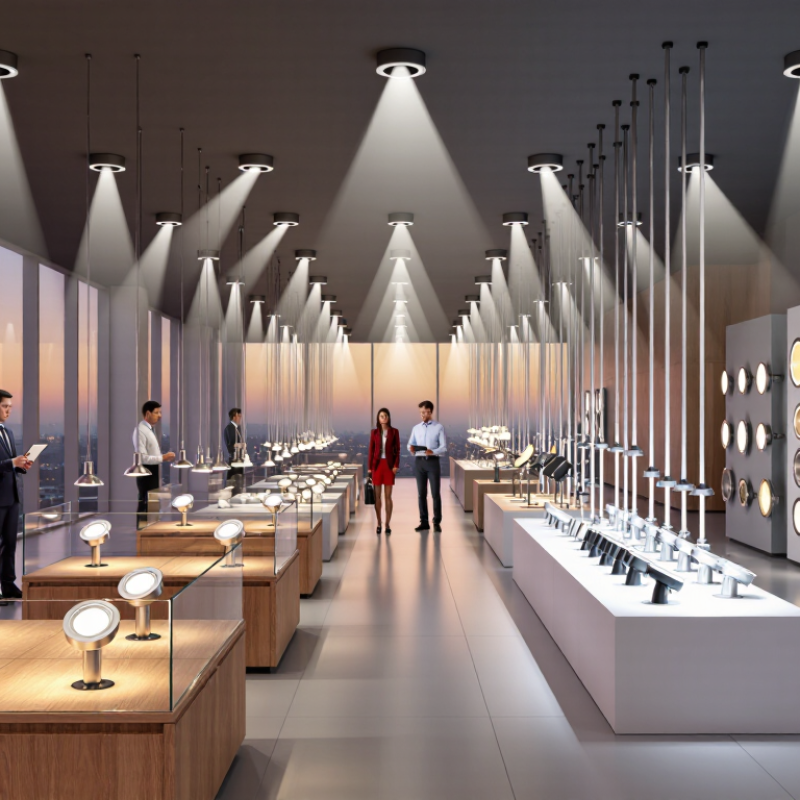
A Chinese LED spotlight supplier is defined by more than a catalog and a competitive quote. Look for clear technical data: beam angle, lumen output, color consistency, driver specifications, and operating temperature. A supplier should explain how these figures were measured, not just place them on a product sheet. Ask for photometric files and sample test records. Details matter.
Production capability shows up in ordinary things. Can the supplier explain its binning process, inspect solder joints, and track components by batch? Ask how it checks heat dissipation after extended operation. A well-built spotlight should manage warmth around its housing, lens, and driver. Request a sample and inspect its finish, wiring, and light distribution yourself. One sample is not proof of consistent production, though.
Communication is another useful measure. Reliable teams answer technical questions directly, flag limits in a custom design, and provide realistic lead times. They should describe packaging, inspection steps, and how they handle defects without vague promises. Compare answers against documents and sample results. No checklist catches everything. I would still verify a second production batch, especially when color matching matters. A supplier’s quality system is only as convincing as the records and products buyers can actually review.

For global buyers, supplier evaluation should start with measurable performance, not catalogue claims. The U.S. Department of Energy’s Energy Saver guidance reports that:
These figures are useful benchmarks, not guarantees for every spotlight. Ask suppliers for product-specific photometric data, including beam angle, center-beam intensity, color temperature, and color-rendering index.
Review LM-79 test results for complete luminaires, plus LM-80 data and TM-21 projections for LED package maintenance where applicable. Check whether the test conditions match your intended voltage and operating environment.
Then assess a physical sample: measure illuminance at the target distance, inspect the beam edge on a wall, and check heat-sink temperature after extended operation. A 35-degree beam can look convincing in a datasheet yet leave dark patches across a display.
Numbers need context. Request production-control records and warranty terms, and compare samples from separate production runs when feasible. A tidy report may still miss batch variation, so supplier paperwork should support—not replace—verification.
China’s LED spotlight suppliers differ in optics, housing, controls, and production scale. These ten profiles describe useful supplier types, not a verified ranking. One focuses on compact track lights for retail displays; another makes adjustable downlights for homes and hotels. A third offers narrow-beam spotlights for galleries, while a fourth specializes in outdoor-rated fixtures. One supplier may provide custom aluminum housings. Another may focus on dimming options and driver compatibility. The remaining profiles cover COB modules, low-glare designs, export-ready packaging, and small-batch customization. Details vary by model, so confirm specifications directly.
Tips: Request test reports, beam-angle charts, and sample units. Check color consistency between samples and bulk orders. Ask how the supplier handles driver replacements. Small details matter.
A polished catalog is not proof of stable production. Compare stated wattage with measured output, and inspect heat dissipation after extended operation. Some suppliers offer impressive customization but have longer lead times; others ship faster with fewer options. Trade-offs happen. Confirm warranty terms, production capacity, and inspection procedures in writing before placing an order. I would also revisit any “top ten” list that gives no selection criteria; ranking claims need evidence.
When comparing China’s LED spotlight suppliers, product breadth matters less than how clearly each specification is documented. The IEA’s Energy Efficiency 2023 report notes that LEDs reached about 50% of global lighting sales, up from 5% in 2013. That shift makes dependable performance data essential. Buyers should compare beam angles, colour rendering, lumen output, dimming options, and driver details—not just wattage. A narrow 15-degree beam may suit a display shelf but create harsh hotspots in a small room.
Service separates capable suppliers from catalogue sellers. Ask for photometric files, sample units, production lead times, and written warranty terms. Check whether supplied test data identifies the exact model and operating conditions. A supplier that answers technical questions clearly can reduce costly revisions. Small details count. For example, confirm whether a sample uses the same driver and lens as bulk production.
Some comparisons still lean too heavily on price and headline efficacy. That is an imperfect shortcut. A lower-cost spotlight may need more units to deliver even coverage, while vague service commitments can complicate replacement orders. Compare a few shortlisted products under the same installation conditions, including dimming behaviour and heat around the fixture. No catalogue can fully replace that check.
A polished catalog is not proof of dependable production. Ask each supplier for a current business profile, factory address, and clear description of its role. Some companies manufacture products; others coordinate production through partner factories. That distinction matters when samples and bulk orders need to match.
Request a sample with the exact LED, driver, housing, and finish proposed for production. Measure its beam angle, color temperature, brightness, and color rendering against your project requirements. Run it for several hours and check for flicker, unusual heat, or loose fittings. Small details show up quickly. Ask for relevant test reports, and confirm that model numbers on documents match the product being quoted. A report alone cannot confirm a sample’s performance.
Before placing a large order, arrange a video walkthrough or independent factory inspection. Review assembly, aging tests, and final inspection records, not just the showroom. Confirm carton dimensions, labeling, spare-part availability, lead time, and written defect procedures. Put approved specifications and sample photos into the purchase agreement. I still treat remote checks as imperfect; a camera can miss inconsistent batches. For a first order, consider a smaller quantity and inspect products before shipment. Keep communication in writing, especially when a specification changes.
Supplier comparison checklist: The table below lists ten practical verification areas for comparing supplier candidates. It is not a ranked list of companies or a claim that any supplier has passed these checks.
| No. | Verification area | Evidence to request | How buyers can check it | Warning signs |
|---|---|---|---|---|
| 1 | Business identity and role | Current business registration details, registered address, business scope, and a written statement of whether the seller is a manufacturer, trading company, or both. | Check the registration through the relevant official registry where available. Confirm that the contracting, invoicing, and payment entities are clearly identified. | Inconsistent legal names or addresses; reluctance to explain who makes the product or who will sign the contract. |
| 2 | Factory and production capability | Facility address, production-process overview, relevant equipment list, and recent factory-audit records if available. | Arrange a live video tour or independent audit. Check that the facility and processes shown are relevant to the quoted spotlight model. | Only generic facility photos; inability to show production or quality-control processes for the product category. |
| 3 | Product specification | Datasheet stating input voltage and frequency, power, luminous flux, beam angle, CCT, CRI, dimming method, dimensions, and operating conditions. | Compare the datasheet with the quotation, sample label, and packaging. Ask the supplier to identify the exact model and configuration being offered. | Specifications that omit test conditions, use inconsistent model numbers, or change between quotation and sample. |
| 4 | Photometric performance | Product-level photometric or electrical test reports where applicable, including test laboratory, report date, model, and tested configuration. | Check that the report covers the same complete luminaire and configuration—not just an LED component—and that reported values match the product documentation. | Component data presented as proof of complete-fixture performance; reports with no traceable model or test details. |
| 5 | Safety and market compliance | Declarations and test or certification documents applicable to the destination market and the specific product model. | Confirm requirements for the destination country with the relevant regulator, importer, or qualified compliance professional. Verify document scope, model coverage, and validity with the issuing body where possible. | A generic “CE” claim with no supporting documentation; certificates that cover a different model, factory, or product type. |
| 6 | LED and driver components | Bill of materials or component specifications for the LED source, driver, optics, housing, and thermal-management design; approved alternatives should be disclosed. | Ask whether substitutions require buyer approval and whether a component change triggers renewed testing or sample approval. | Unannounced component substitutions or refusal to document components that materially affect performance or safety. |
| 7 | Quality-control process | Incoming-material, in-process, and final-inspection procedures; inspection records; and the method used to check electrical and lighting performance. | Agree on measurable acceptance criteria before production. Consider a pre-shipment inspection using an approved sample and written inspection plan. | Quality described only as “strict”; no defined checks, records, or process for handling nonconforming goods. |
| 8 | Sample and production consistency | Pre-production sample, approved specification sheet, sample identification, and written confirmation that mass production will follow the approved configuration. | Keep a signed or otherwise traceable reference sample. Compare production samples or inspection results against it, including finish, dimensions, optics, and electrical details. | Supplier cannot identify the approved sample or treats sample approval as covering unspecified future changes. |
| 9 | Order terms and delivery | Itemized quotation, minimum order quantity, lead time, payment terms, Incoterm and named place, packaging details, and warranty terms. | Put model, specifications, tolerances, inspection rights, delivery dates, and remedies for nonconformity into the purchase agreement. Clarify who arranges freight, insurance, and export documents. | Vague delivery or warranty commitments; payment instructions that do not match the contracting entity without a documented explanation. |
| 10 | Traceability and after-sales support | Batch or date-code method, contact for technical support, spare-parts policy, warranty-claim procedure, and records retained for production lots. | Ask how a specific shipment can be traced to its production batch and how defects are investigated, documented, and resolved. | No identifiable production lots, unclear claim process, or no written response-time and resolution procedure. |
Practical sourcing sequence: Shortlist candidates, verify the legal entity and product documents, approve a representative sample, define inspection and acceptance criteria in writing, and inspect the shipment before release of final payment where contractually agreed. Compliance obligations vary by product and destination market.

We have over 30 years of experience in designing complete hydraulic systems, repairs and distribution of fluid power equipment and parts.
FOLLOW US ON :
Address:
4020 SE 45th CT.
Ocala, FL 34480
Phone No:
Email:
sales@cunninghamfluidpower.com