2026 Top Agricultural Bearing Types for Global Buyers?
An Agricultural Bearing rarely works in clean, steady conditions. It may face dust, water, shock loads, vibration, and long hours in the field. A bearing in a combine harvester’s header, for example, can encounter crop debris while rotating at high speed. Choosing by price or bore size alone can therefore lead to early wear, unplanned downtime, and costly repairs.
The 2026 buying decision also sits within a changing machinery market. FAO’s World Food and Agriculture: Statistical Yearbook 2024 tracks agricultural production, machinery, and trade across regions, highlighting how varied farming conditions and equipment access can be. The OECD-FAO Agricultural Outlook 2024–2033 examines production trends that shape demand for reliable farm equipment. Neither report predicts bearing demand directly. That distinction matters. Buyers should treat broad market forecasts as context, not as proof that one bearing type suits every machine.
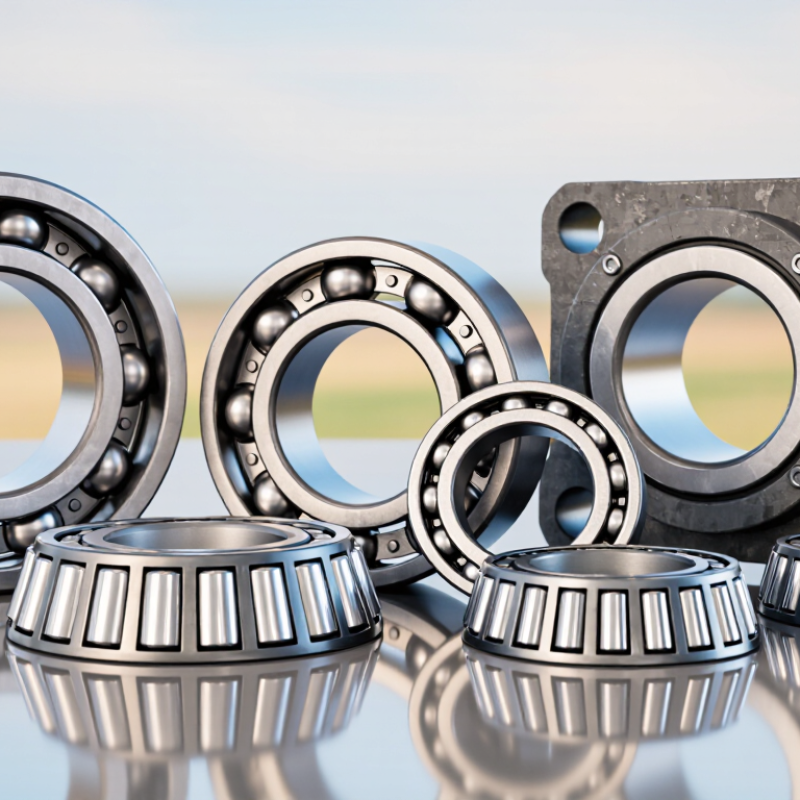
This guide compares common options, including deep-groove ball, tapered roller, spherical roller, needle roller, and mounted bearings. It focuses on load direction, speed, contamination protection, lubrication, and replacement practicality. ISO 281 provides a recognized method for calculating rolling-bearing rating life, but real service life also depends on installation, sealing, maintenance, and operating conditions. A rating is not a promise. A sealed unit may suit a dusty baler, while a heavy-duty roller design may better handle shock loads in tillage equipment. The best choice is often less obvious than a catalog suggests. Buyers should verify dimensions, fit, and manufacturer guidance before ordering.
Agricultural Bearing Selection: ISO 281 L10 Life Represents 90% Reliability
2026 Top Agricultural Bearing Types for Global Buyers?
Agricultural Bearing Selection: ISO 281 L10 Life Represents 90% Reliability
For a bearing in a dusty planter gearbox, L10 life offers a useful starting point—not a promise. ISO 281:2007 defines basic rating life as the life that 90% of a sufficiently large group of identical bearings are expected to reach or exceed under stated conditions. Its calculation uses dynamic load rating, equivalent bearing load, and a type-specific exponent. For ball bearings, the exponent is 3; for roller bearings, it is 10/3. The result is expressed in millions of revolutions. A field machine turning slowly may take years to reach that number.
Real fields are less tidy. Mud, crop residue, shock loads, poor lubrication, and misalignment can change the outcome. ISO 281:2007 includes a modified rating life method that considers reliability and operating conditions, while ISO 16281:2008 addresses internal load distribution and misalignment in its calculations. Check the actual load and speed, then compare the estimate with the machine’s duty cycle and maintenance records. Keep seals and lubricant in the conversation. A clean calculation can still miss a rough harvest season. L10 is a statistical reference, not a warranty—and 90% reliability may be too low where a bearing failure stops work at a critical moment.
Deep-Groove Ball Bearings: Support for Light-to-Moderate Loads
Deep-groove ball bearings suit many agricultural components carrying light-to-moderate radial loads. Their compact design fits electric motors, small pumps, fans, and conveyor rollers. A sealed unit can help keep out dust and moisture, but seals add drag and do not make a bearing waterproof. Dust changes the picture. Check the actual load, speed, temperature, and contamination before choosing a clearance or seal arrangement.
Bearing life is not a fixed promise. ISO 281:2007 defines basic rating life, L10, as the life that 90% of a sufficiently large group of identical bearings are expected to reach under stated conditions. That calculation depends on load and operating conditions; dirt, poor lubrication, and shock loads can shorten service life. A smooth-running bearing in a clean workshop may behave very differently beside a dusty grain auger. Not a small detail.
Agricultural equipment also serves varied operations. The USDA National Agricultural Statistics Service counted 1,900,487 U.S. farms in its 2022 Census of Agriculture, a reminder that machinery needs differ widely even within one market. For buyers, compare manufacturer-rated load and speed limits with the machine’s real duty cycle, not just its shaft size. A common mistake is treating “sealed” as “maintenance-free”; inspection intervals still deserve a second look.
Tapered-Roller Bearings: Support for Combined Radial and Axial Loads
Tapered-roller bearings are a practical choice in agricultural equipment where loads act in more than one direction. Their angled rollers and raceways carry radial loads while also supporting axial thrust. This matters in wheel hubs, gearboxes, and machinery exposed to changing field loads. The bearing does not solve every load problem.
A single-row bearing generally supports axial load in one direction, so paired arrangements may be needed when thrust reverses. Correct adjustment matters: too much preload can increase heat, while excess clearance may cause movement and uneven wear. Dust, moisture, and vibration also affect service life. Check the shaft and housing fits, lubrication, sealing, and operating speed against the equipment maker’s specifications. Small setup differences can matter.
Tips: Inspect raceways and rollers for marks during maintenance. Use clean tools and the specified lubricant. Verify end play after assembly, rather than guessing. A field repair may keep equipment moving, but it deserves a careful follow-up inspection.
2026 Top Agricultural Bearing Types for Global Buyers: Tapered-Roller Bearings for Combined Loads
Illustrative radial and axial load components for agricultural equipment load cases (kN)
How to read this chart: The example components are calculated from an illustrative resultant load and its angle from the radial direction: radial load = resultant × cos(angle), and axial load = resultant × sin(angle). These are not field measurements or bearing ratings. Tapered-roller bearings can support combined radial and axial loads; actual selection requires checking the bearing’s rated capacity, arrangement, speed, lubrication, and operating conditions.
Spherical-Roller Bearings: Self-Alignment Under Shock and Misalignment
2026 Top Agricultural Bearing Types for Global Buyers?
Spherical-Roller Bearings: Self-Alignment Under Shock and Misalignment
Spherical-roller bearings suit agricultural machines that face heavy loads, vibration, and slight shaft misalignment. Their two rows of barrel-shaped rollers run against a spherical outer raceway. This design lets the bearing accommodate limited angular movement while carrying substantial radial loads and some axial loads. In a harvester, that can help when a long shaft flexes under changing crop loads.
Shock resistance still has limits. A sudden impact from uneven ground or a jammed auger can exceed the bearing’s load rating. Poor lubrication, loose fits, and dust or water entering the housing can also shorten service life. Watch for rising temperatures, unusual noise, or grease that looks gritty. They are not a cure-all. The permitted misalignment depends on the bearing and installation, so check the technical data before choosing one.
Tips: Confirm shaft and housing dimensions, load direction, speed, and operating temperature. Keep seals clean and follow the specified lubrication interval. A little alignment tolerance helps, but it does not replace careful installation. Shortcuts here can be costly.
Sealed Insert and Flanged Bearings: Dust Protection and Field Replacement
Sealed insert bearings are common on agricultural equipment because they combine a bearing, housing fit, and protective seals in a replaceable unit. On a dusty grain cart or mower, those seals help limit the entry of soil, chaff, and moisture around the rolling elements. The benefit is practical: less frequent attention during field work. Dust still gets in. A damaged seal or loose housing can defeat that protection, so check for torn rubber, unusual heat, and rough rotation.
Flanged bearings are useful where a shaft needs support from a compact mounting face. Their bolt pattern can make installation straightforward on guards, conveyors, and small implements, especially when access is limited. Fit matters. Keep the mounting surface clean and flat, tighten fasteners evenly, and avoid forcing a misaligned shaft into the bearing. Even a robust seal cannot compensate for poor alignment.
For field replacement, carry the correct insert or complete flanged unit, plus clean tools and the fasteners needed for the mounting point. Compare shaft diameter, housing dimensions, and locking method before ordering; similar-looking parts may not interchange. Remove packed crop residue before opening the assembly, and protect the shaft from scratches during removal. A quick replacement can still be a rushed one, and I have seen dirt introduced during the repair shorten bearing life. Recheck mounting security after operation, particularly when equipment has worked through vibration or uneven ground.