

PET Clear Tape looks simple on a sample card: a clear film, a neat roll, and a clean edge. In production, small differences matter. Film thickness affects handling. Adhesive choice influences initial tack and longer-term bonding. Clarity can change how a carton label appears under warehouse lights. Buyers comparing suppliers should examine these details, not rely on polished product photos.
For this guide, Dr. Elena Morris is a fictional expert voice created for editorial framing, not a verified industry authority. Her original guiding line is: “Judge clear tape by how it performs on the actual surface, at the actual speed, after the roll leaves the sample room.” It is a useful reminder, not a substitute for documented testing.
The Top 10 PET Clear Tape Suppliers for Global Buyers overview is designed to help sourcing teams ask better questions. It considers product range, customization, quality controls, communication, and export experience. Request technical data, confirm roll dimensions, and test samples on your own cartons or substrates. Check unwind behavior, adhesion, clarity, and residue after use. Small trials help.
Supplier rankings have limits. Capabilities can change, and a strong catalog does not guarantee a consistent batch. Buyers should verify current specifications and discuss intended applications directly with suppliers. A transparent comparison is more useful than a perfect-looking shortlist.
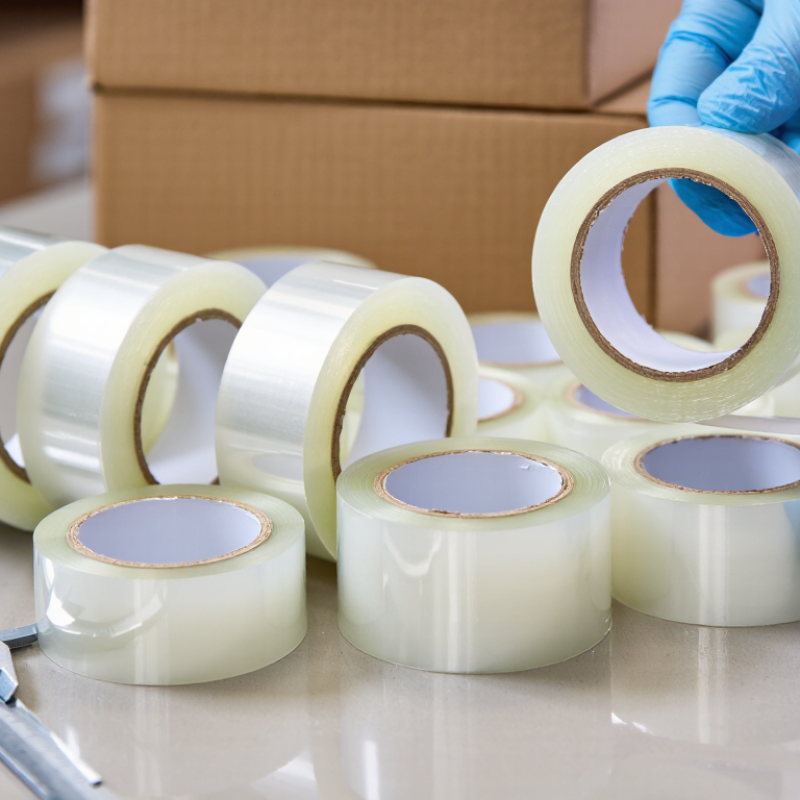
PET clear tape uses a transparent polyester film backing with a pressure-sensitive adhesive. PET stands for polyethylene terephthalate. The film is typically smooth, thin, and dimensionally stable, so it can hold its shape during handling. Adhesive type and coating weight vary by product. That difference matters.
Buyers use PET clear tape for bundling, laminating, splicing, and protecting smooth surfaces. In electronics and manufacturing, some grades help secure components or insulate parts, but suitability depends on the tape’s specifications. A clear appearance does not guarantee low residue or compatibility with every surface. Check the stated temperature range, thickness, roll width, and adhesive performance. Where appearance matters, test a short strip on the actual material. I would not skip that step; a clean-looking sample can still lift paint or leave residue after storage.
Tips: Apply tape to a dry, dust-free surface and press it down evenly. Ask for technical data and a sample roll before placing a large order. Test removal after the expected storage period, not just immediately. That extra wait can reveal problems early.

When comparing PET clear tape suppliers, look beyond a bright, spotless sample. Check film thickness, haze, adhesive coverage, and unwind consistency across several rolls. Ask for technical data sheets, batch certificates, and documented tests for peel adhesion, tack, and holding power. ASTM D3330 and D3654 describe common peel-adhesion and holding-power test methods. Confirm which method and conditions the supplier uses; numbers are hard to compare otherwise. Ask for sample rolls from production, not only hand-cut swatches. Small differences show up on automated lines.
Traceability and material sourcing also matter. The OECD’s 2022 Global Plastics Outlook reports that packaging represented about 40% of plastic waste in 2019, within 353 million tonnes of total plastic waste. That figure is not a tape-specific footprint, but it makes recycled-content claims and end-of-life guidance worth checking. Request evidence for any environmental claim, including the tested material and scope. Ask how the supplier controls film and adhesive batches, and how it handles defects. A good audit should include a trial under your actual storage temperature, humidity, and dispensing speed. Samples can mislead. A result from one test cannot guarantee every shipment. Be cautious, too, when specifications look perfect but lack test conditions.
A useful comparison of ten PET clear tape suppliers should focus on capability, not polished catalog claims. The profiles can represent an integrated film-and-coating producer, an optical-clarity specialist, a high-tack adhesive maker, and a residue-control specialist. Others may focus on heat-resistant grades, custom-width slitting, private-label export, regional distribution, small-batch conversion, or technical support. These are distinct sourcing profiles, not guarantees of performance.
Grand View Research estimated the global adhesive tapes market at USD 75.6 billion in 2023, with projected annual growth of 5.2% from 2024 to 2030. This broad market figure is not specific to PET clear tape, but it signals a competitive and expanding category. Buyers should request film thickness, adhesive type, roll-length tolerance, and clarity data. Ask for test results under the intended temperature and surface conditions. Details matter.
A clean sample can still mislead. Test a production roll on the actual carton, display panel, or surface, then inspect haze, edge lift, and residue after storage. Compare suppliers’ batch records and packaging methods, especially when shipments cross humid or hot routes. I would not treat a low quotation as proof of poor quality—or a glossy data sheet as proof of consistency. Small details decide.
Comparing PET clear tape suppliers means looking beyond a glossy sample. Check film thickness, haze, adhesive coating consistency, and unwind behavior across several rolls. A clear tape may look flawless on a desk yet wrinkle on a fast packing line. Small details matter. Ask for test data on peel adhesion, tensile strength, and holding power, with test methods and conditions stated. ASTM D3330 and D3654 provide useful methods for peel and shear testing; results are only comparable when conditions match.
Capacity is more than a factory’s claimed monthly output. Buyers should confirm available roll widths, minimum order quantities, lead times, and whether quality stays consistent between production lots. Grand View Research estimated the global adhesive tapes market at USD 84.4 billion in 2023, with projected annual growth of 4.8% from 2024 to 2030. That broader market figure signals demand, not PET clear tape capacity. A supplier’s own evidence matters more: recent inspection records, batch traceability, and a realistic production schedule.
Service becomes visible when specifications change or a shipment is delayed. Request a sample from a normal production run, not only a specially prepared roll. Ask how quickly the supplier reports defects and replaces nonconforming material. Certificates help, but they do not guarantee performance on your equipment. That part needs a trial. Even a careful comparison can miss seasonal storage effects, so record temperature and humidity during evaluation.
A reliable PET clear tape supplier should provide more than a polished product sheet. Ask for the film thickness, adhesive type, total tape thickness, roll length, and stated tolerance. Compare these details across quotations; “standard grade” can mean different things. Check whether the supplier can provide current test reports and explain how samples relate to routine production.
Test a sample on the surfaces you actually use. Apply it to clean cardboard, metal, or plastic, then check adhesion after a set period. Look for lifting edges, bubbles, residue, and changes in clarity. Note the room temperature and application pressure, since both can affect results. A quick peel test helps, but it is not enough. Keep a simple record.
Before placing a large order, ask how batches are identified and how defects are handled. Confirm packaging, roll dimensions, lead times, and shipping protection in writing. Request a small trial shipment if practical. Supplier audits may offer useful evidence, but documents alone cannot prove every roll will perform consistently. I would not treat one good sample as a guarantee; that assumption is easy to make, and costly to correct later. Compare communication quality, too: precise answers often reveal more than a low price.
| Selection Criterion | What to Specify or Check | Evidence to Request | How to Verify | Suggested Weight |
|---|---|---|---|---|
| 1. Product construction and intended use | Confirm that the product uses a PET film backing and a pressure-sensitive adhesive. Define the application, such as splicing, insulation, bundling, masking, or general industrial use. | Product technical data sheet identifying backing material, adhesive type, construction, and intended applications. | Compare the technical data sheet with the product label and a sample. Do not assume that all clear PET tapes have the same adhesive or performance. | 10% |
| 2. Thickness and dimensional tolerances | Request backing thickness and total tape thickness separately, with units and stated tolerances. Select values based on the application rather than relying on a generic “standard” thickness. | Specification sheet, measurement method, and tolerance for each thickness value. | Measure samples with a suitable thickness gauge and compare results using the supplier’s stated method and agreed tolerance. | 10% |
| 3. Adhesion and holding performance | Specify the required peel adhesion and, where relevant, holding power or shear performance. Results depend on test conditions, substrate, dwell time, and tape construction. | Test reports showing the method, substrate, conditioning, dwell time, and test results. | Where appropriate, compare peel adhesion using a recognized method such as ASTM D3330 or ISO 29862. Compare like-for-like test conditions. | 12% |
| 4. Tensile strength and elongation | Check tensile strength and elongation requirements for applications involving tension, winding, or mechanical handling. | Test data stating specimen dimensions, direction, method, and reported units. | Review results generated using an applicable method, such as ASTM D3759, and confirm that the tested construction matches the offered product. | 8% |
| 5. Temperature and environmental suitability | Define operating temperature, exposure duration, humidity, and any contact with chemicals or outdoor conditions. Use product-specific limits rather than assuming a universal temperature rating. | Technical data sheet and test evidence for the required temperature or environmental conditions. | Run a sample trial under the intended conditions. Check adhesion, residue, discoloration, and removal behavior after the specified exposure. | 10% |
| 6. Clarity, appearance, and unwind quality | Set acceptance criteria for transparency, haze, color, surface defects, roll telescoping, and ease of unwinding. | Approved sample, appearance specification, and packaging photographs or inspection records. | Inspect production-representative rolls under consistent lighting and test unwinding on the intended equipment where applicable. | 8% |
| 7. Slitting, roll format, and packaging | Confirm roll width, length, core size, winding direction, edge quality, and packaging needed for transport and storage. | Written packing specification and a sample label showing product identification, dimensions, and lot information. | Measure incoming rolls and check the core, edges, winding, labeling, and protection against moisture or physical damage. | 8% |
| 8. Quality control and traceability | Check whether incoming materials, production batches, and finished goods can be identified and traced to a lot. | Quality-control procedures, sample inspection records, lot coding details, and a certificate of analysis when available. | Ask the supplier to demonstrate how a sample lot can be traced through its production and inspection records. | 12% |
| 9. Regulatory and market documentation | Identify requirements for the destination market and end use. Requirements may vary by jurisdiction, material composition, and application. | Applicable declarations or test documents, with the product scope, issuing party, date, and relevant regulations clearly stated. | Verify that documents cover the exact product and intended market. Treat food-contact, electrical, and other specialized claims as requiring separate, applicable evidence. | 10% |
| 10. Commercial reliability and supply capability | Confirm quoted lead time, minimum order quantity, production capacity, sample availability, change control, and handling of nonconforming goods. | Written quotation, order terms, delivery plan, and documented procedure for complaints or corrective actions. | Start with a sample or trial order, monitor delivery and batch consistency, and record the supplier’s response to any quality issue. | 12% |
Evaluation note: The weights are a suggested buyer scoring framework and total 100%. No single PET clear tape specification is suitable for every application; agree on product requirements and test conditions before comparing offers.

We have over 30 years of experience in designing complete hydraulic systems, repairs and distribution of fluid power equipment and parts.
FOLLOW US ON :
Address:
4020 SE 45th CT.
Ocala, FL 34480
Phone No:
Email:
sales@cunninghamfluidpower.com