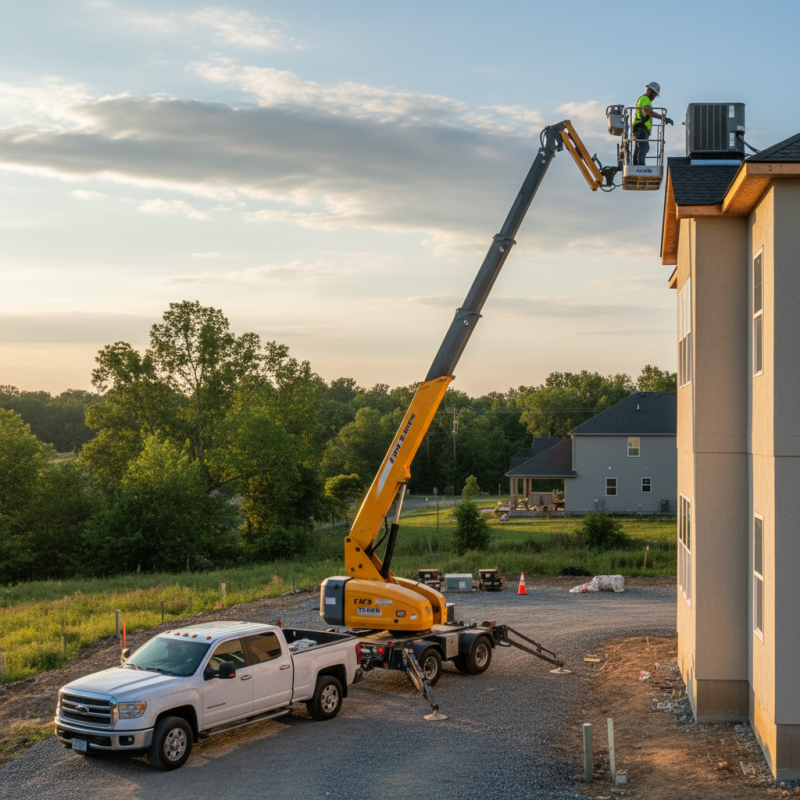
What is a Towable Boom Lift and How Does It Work?
The Towable Boom Lift is an ingenious machine designed for lifting workers and equipment to reach high places with ease. This versatile equipment can extend up to impressive heights while ensuring stability. It operates using a towable design, allowing easy transportation to various job sites.
With the Towable Boom Lift, users can access rooftops, ceilings, and other elevated structures. Its compact size makes it suitable for narrow spaces where larger lifts cannot operate. The beauty of this lift lies in its simplicity and efficiency. However, proper training in its use is crucial for safety.
Despite its advantages, the Towable Boom Lift comes with challenges. Users must occasionally face road restrictions and setup difficulties. Operating at heights requires careful planning and attention. Reflecting on these issues can help improve overall safety and effectiveness during use.
Definition and Purpose of a Towable Boom Lift
A towable boom lift is a versatile aerial work platform. It is designed to be towed by vehicles, making it easy to transport. This equipment allows access to elevated areas, often needed for maintenance or construction. The boom extends high, providing a stable working platform for workers. The primary purpose is to reach difficult heights safely and efficiently.
When using a towable boom lift, it's crucial to assess the work area. Check for overhead obstructions such as power lines or trees. These could pose risks during operation. Also, consider the ground conditions. Soft or uneven ground may affect stability.
Tips for using a towable boom lift include conducting a pre-operation inspection. Ensure the lift is in good working condition. Pay attention to the hydraulic system and safety features. Training is essential for all operators. Understand the lift’s controls and how it functions. Improper use can lead to accidents. Always have a safety plan in place before you start.
Key Features and Components of Towable Boom Lifts
Towable boom lifts are versatile machines used for aerial work. They are designed to be easily transported. The design includes a boom that can extend upwards, allowing operators to reach high places safely. These lifts are popular in construction and maintenance industries.
Key features of towable boom lifts include adjustable outriggers, which stabilize the equipment during operation. They often have electric or hydraulic systems for extending and retracting the boom. A platform or basket at the end can hold one or two workers, enhancing productivity. The control system is usually user-friendly and allows operators to maneuver the lift with ease.
Tips: Always inspect the lift before use. Check for damage or wear. Ensure that all components are functioning correctly. The average working height for these lifts ranges from 30 to 50 feet, depending on the model. However, it is vital to consider safety limits. Operators often overlook weight capacity. Remember, overloading can cause accidents.
Towable boom lifts are compact, making them suitable for tight spaces. Their ability to navigate through narrow pathways is a significant advantage. However, some users may struggle with setup.
Training is essential. Understanding all components can save time and avoid mishaps.
How Towable Boom Lifts Operate: Mechanism and Functionality
Towable boom lifts are versatile machines designed for a variety of tasks. They offer an easy and effective way to reach high places. At their core, these lifts use a combination of hydraulics and mechanical systems for operation. The boom extends from a trailer, allowing for height adjustments. The operator can easily maneuver the lift into position with the help of a vehicle. However, setting it up correctly can be tricky and often requires practice.
Mechanically, towable boom lifts consist of a telescoping or articulating arm, which can be raised and lowered. The hydraulic system pushes the boom upward, while the stability provided by the trailer base ensures safety. Operating the lift involves using controls to position the boom precisely. Yet, not all operators realize how significant terrain impact can be. A stable surface is critical; uneven ground may lead to accidents.
The functionality of towable boom lifts hinges on their design simplicity. Still, one must understand their limitations. For example, wind conditions can affect stability at higher elevations. It's vital to assess both the device and surrounding environment. Operators often underestimate these factors, which can lead to unsafe situations. Being aware of such risks enhances overall safety and efficiency on the job site.
Towable Boom Lift Performance Comparison
Applications and Industries Utilizing Towable Boom Lifts
Towable boom lifts are versatile machines used across various industries. Construction sites often rely on these lifts for tasks at elevated heights. The ability to extend reaches up to 50 feet is a game-changer. This flexibility is crucial for window installations and roof repairs. According to industry reports, demand for boom lifts is expected to rise by 4.5% annually by 2025.
In the film industry, towable boom lifts are crucial for filming scenes from above. They provide a unique perspective difficult to achieve otherwise. Events and festivals also benefit from these lifts. High-quality lighting and sound systems require elevated setups. A report from Rental Equipment Register indicated a 15% increase in boom lift rentals during peak event seasons.
Tips: Regular maintenance is key. Check hydraulic systems often and inspect safety features. Always ensure operators are trained. Proper training promotes safety and efficiency. Even a small oversight can lead to serious issues. Remember, safety cannot be compromised for convenience.
Safety Considerations When Using a Towable Boom Lift
Using a towable boom lift can be highly efficient, but safety must always come first. According to the American National Standards Institute (ANSI), many accidents happen due to improper usage. Ensuring the stabilizers are fully deployed is crucial. A study by the International Safety Equipment Association (ISEA) shows that nearly 30% of injuries from aerial lifts arise from falls. Proper harness usage can significantly reduce this risk.
Before operating, perform a thorough inspection. This should include checking the brakes, tires, and hydraulic systems. The Occupational Safety and Health Administration (OSHA) states that up to 40% of lift accidents stem from mechanical failures. Operators must be trained. A survey revealed that untrained workers are 70% more likely to encounter safety incidents.
Weather conditions also require careful consideration. Wind speeds exceeding 20 mph can pose a serious hazard. Always monitor forecast updates, as ignoring these can lead to disastrous outcomes. Despite the convenience, operators must remain vigilant and proactive about safety protocols to help prevent accidents. Reducing risks is a shared responsibility.
What is a Towable Boom Lift and How Does It Work? - Safety Considerations When Using a Towable Boom Lift
| Feature | Details |
| Definition | A towable boom lift is a mobile elevating work platform that can be towed by a vehicle to different job sites for aerial work. |
| Working Mechanism | Operates using hydraulic systems to extend and elevate the platform to access high places. |
| Common Uses | Maintenance, construction, and painting tasks at heights unreachable by ladders. |
| Safety Considerations | Always wear a harness, ensure the ground is stable, and be aware of overhead hazards. |
| Training Requirements | Operators should be trained and certified to use towable boom lifts. |
| Weight Capacity | Typically ranges from 300 to 500 pounds, depending on the model. |
| Maintenance | Regular inspections and maintenance are required to ensure safety and functionality. |