What Is a Triangular Screen Used For?
A Triangular Screen is a screening surface built around triangular-profile wires or openings. In many industrial designs, the wire’s shape creates narrow, controlled slots. These slots separate particles by size while allowing liquid or finer material to pass. You may see this construction in aggregate processing, mineral plants, and liquid-solid separation systems. Its purpose depends on the panel design, opening size, material, and machine—not its name alone.
The scale of aggregate processing shows why screening details matter. The U.S. Geological Survey’s Mineral Commodity Summaries 2024 estimated U.S. crushed-stone output at about 1.5 billion tons in 2023. That material serves construction and infrastructure markets, where consistent grading supports downstream production. On a plant floor, a screen may sort damp stone, drain slurry, or remove oversize pieces before crushing. Small details count. Slot width, feed rate, and cleaning method can affect throughput and product consistency. Triangular-profile media may help reduce clogging in some applications, but results vary with the feed and operating conditions. No screen fits every job. Buyers should check the material specification and test performance under realistic conditions; product descriptions alone rarely tell the whole story. This guide explains what a Triangular Screen is used for, how its geometry works, and which practical factors influence selection.
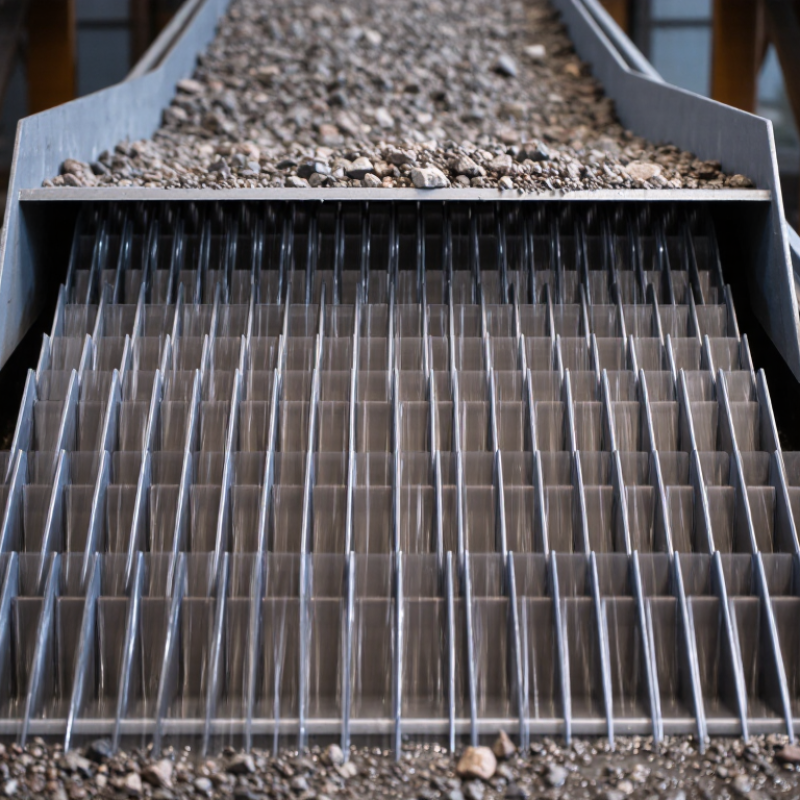
Triangular Screen Construction: V-Shaped Wires and 0.1–10 mm Slot Openings
A triangular screen uses V-shaped wires to create narrow, continuous openings across its surface. The wider side of each wire faces the incoming material, while the slot narrows toward the support structure. This shape helps particles pass through without wedging as easily as they might in a straight-sided opening. It also gives liquid or fine material a clear path through the screen.
Slot openings commonly range from 0.1 to 10 mm, depending on the screening task. A 0.1 mm slot can retain very fine particles, but it may need more frequent cleaning if the feed contains sticky matter. Larger openings allow higher flow and handle coarser material, though smaller particles may pass through. That detail matters. Slot size should match the actual particle distribution, not just the target size on a drawing. Feed moisture, pressure, and the direction of flow also affect performance. A wider slot is not automatically better. Not always.
Support rods hold the V-shaped wires in place and help the screen withstand operating loads. During inspection, look for uneven wear, blocked slots, or damaged joints; even a small worn area can change separation quality. The design is durable, but it is not maintenance-free. Teams sometimes overlook that.
How Continuous Slots Support Filtration and Reduce Particle Bridging
What Is a Triangular Screen Used For?
A triangular screen is used to separate solids from liquids or gases while allowing the fluid to pass through. In a wedge-wire design, each wire forms a narrow opening at the screen surface that widens behind it. This creates continuous slots rather than isolated round holes. The screen may be used in water intakes, process filtration, or equipment that needs to retain particles while maintaining flow.
The slot shape can help reduce particle bridging. Bridging happens when particles collect across an opening and block others from passing through. With a narrow outer edge and a wider inner passage, particles are less likely to lodge tightly in the slot. That matters. In practice, though, performance depends on particle size, shape, and the material being filtered. Fibrous debris or sticky solids can still build up, so a triangular screen is not self-cleaning in every application.
Slot width should be chosen to match the particles that need to be retained, while accounting for expected flow and cleaning methods. A slot that is too narrow may restrict flow; one that is too wide may let unwanted solids through. Measure the actual process conditions where possible. Even careful sizing involves some uncertainty, because particles rarely behave like uniform test samples.
What Is a Triangular Screen Used For?
Continuous slots provide a consistent opening for filtration. A wedge-shaped profile that widens behind the slot can help particles pass through instead of lodging in the opening.
Illustrative Open Area by Slot Width
How to read this chart: These values are calculated examples, not measured product data. They assume a constant 0.5 mm wire face and calculate open area as slot width ÷ (slot width + wire face) × 100. Wider slots increase open area, while the selected slot width determines which particles are retained.
Uses in Water Wells, Mining, Wastewater, and Food Processing
A triangular screen, often made from wedge-shaped wire, separates solids while allowing liquid to pass through. In water wells, its V-shaped slots help limit sand entry while maintaining flow. Slot size must match the surrounding formation; a poor match can clog or admit sediment. USGS reported that groundwater supplied about 25% of total U.S. water withdrawals in 2015. That scale makes dependable well screening important. In mining, triangular screens sort ores and industrial materials by particle size. USGS Mineral Commodity Summaries 2024 estimated U.S. industrial sand and gravel production at 110 million metric tons in 2023, illustrating the volume that processing equipment may handle.
At wastewater facilities, screens intercept rags, grit, and other debris before they damage pumps or obstruct treatment stages. EPA’s 2022 Clean Watersheds Needs Survey estimated $630.1 billion in wastewater and stormwater infrastructure needs over 20 years. Screens are only one part of that system, but their opening size and cleaning method affect reliable operation.
Food processors use screens to remove unwanted particles from liquids or recover usable product. Smooth screen surfaces can aid cleaning, though sanitation still depends on the full equipment design and operating routine. A common design miss is choosing a slot by particle size alone; flow rate and solids shape matter, too.
Tips: Check slot width, material compatibility, and cleaning access against the actual process. Pilot-test when solids vary. Small differences can matter.
Selecting Slot Size by Particle Distribution and Required Flow Rate
Choosing a slot size for a triangular screen starts with the material, not a guess. Check the particle-size distribution, including the smallest useful particles and the largest pieces the screen must retain. A slot that is too wide can let valuable material pass through. One that is too narrow may trap near-size particles and reduce flow. Shape matters, too: flat flakes and elongated grains can pass through openings differently from round particles of similar size.
Required flow rate sets another constraint. A larger opening often increases capacity, but it can lower separation accuracy. A smaller opening may improve retention while causing slower drainage or more frequent blinding, especially with damp, sticky feed. Leave room for real operating conditions. A dry sample in a tray may behave differently once it meets vibration, pressure, or moisture on the screen. Small details matter.
Compare the expected particle distribution with the screen’s effective open area, then test a representative sample at the intended feed rate. Record throughput and check both the retained material and the undersize. A neat calculation is not always enough. In practice, the first slot choice can be slightly off; that is useful information, not a reason to ignore the data. Adjust the opening only after identifying whether poor flow comes from slot size, feed condition, or screen loading.
What Is a Triangular Screen Used For? - Selecting Slot Size by Particle Distribution and Required Flow Rate
Triangular-profile (wedge-wire) screens are used for particle separation, filtration, and dewatering. Slot size is selected to retain the target particles while allowing the required liquid or gas flow; the examples below are indicative starting points, not guaranteed design capacities.
Example slot selection by feed particle-size distribution | Example feed | D10 (mm) | D50 (mm) | D90 (mm) | Example slot opening (mm) | Typical selection aim | Indicative water flow per m² of screen area (m³/h) |
| Fine sand | 0.10 | 0.18 | 0.30 | 0.10 | Retain most particles near and above the lower end of the distribution | 3–8 |
| Medium sand | 0.25 | 0.45 | 0.75 | 0.25 | Balance particle retention with throughput | 8–18 |
| Coarse sand | 0.50 | 0.90 | 1.50 | 0.50 | Allow higher flow where finer-particle capture is not required | 15–30 |
| Fine gravel | 1.00 | 2.00 | 3.50 | 1.00 | Separate larger granules while maintaining relatively open flow paths | 20–40 |
D10, D50, and D90 are particle sizes below which 10%, 50%, and 90% of the sample lie by measured particle quantity or mass, according to the chosen test method. Flow figures are broad preliminary estimates for clean, low-viscosity water and a clean screen; actual capacity depends on screen geometry, open area, pressure or head, particle shape, solids loading, fouling, and the acceptable pressure drop. Confirm the slot size and capacity with representative material testing and the screen designer.
Comparing Screen Materials, Open Area, and Operating Conditions
What Is a Triangular Screen Used For?
A triangular screen separates solids by size while allowing liquid or finer material to pass through. Its angled, wedge-shaped openings can reduce clogging by limiting particle contact with the slot walls. These screens are used in mineral processing, food production, wastewater treatment, and other separation tasks. The best choice depends on material, open area, and operating conditions—not shape alone.
Stainless steel offers corrosion resistance for wet or chemically demanding service, but it can cost more. Carbon steel often tolerates impact and abrasion, though rust protection may be needed.
Polyurethane can absorb noise and resist wear in some duties, but heat and chemical compatibility must be checked. Open area is the portion of the panel available for flow. More open area may improve throughput, but can leave less supporting material. That trade-off matters.
Check feed size, moisture, temperature, solids loading, and cleaning method before choosing a slot. Damp, clay-rich material may blind narrow openings, even when the specified aperture seems suitable. High impact or vibration also calls for sturdy support and secure fastening. A catalog figure alone can mislead. Compare it with actual operating data, then inspect for uneven wear and blocked slots after a trial run.