

Top PU Sofa Cushion Foam Mould Suppliers Worldwide
Choosing reliable suppliers is essential when a sofa manufacturer needs stable comfort, accurate dimensions, and repeatable production. A Pu Sofa Cushion Foam Mould must do more than create a basic cushion shape. It should support consistent foam density, controlled expansion, clean edges, and dependable cycle times. Small tooling errors can become visible when cushions are assembled. Uneven corners show quickly.
According to polyurethane tooling specialist David Chen, “Good moulds turn foam chemistry into repeatable furniture quality.” This practical view explains why supplier selection requires more than comparing prices. Experienced manufacturers examine aluminium or steel construction, cavity balance, vent placement, heating control, cooling performance, and surface finishing. They also review sample approvals and modification procedures before placing larger orders. Reliable suppliers usually provide technical drawings, trial production, inspection records, and responsive after-sales support. These details matter across international projects, where communication delays can increase tooling risks.
Performance is not everything. Responsible suppliers should also consider material efficiency, repairability, worker safety, and lower production waste. A mould that lasts longer may reduce replacement costs and unnecessary resource use. Still, no supplier is perfect. Some catalogues look impressive, yet their technical support feels limited after delivery. That deserves reflection.
This guide compares leading Pu Sofa Cushion Foam Mould suppliers worldwide through practical criteria. It considers manufacturing experience, engineering capability, quality consistency, customization, delivery reliability, and service responsiveness. The goal is not to promote the largest company automatically. It is to identify suppliers that can convert detailed sofa designs into stable, production-ready moulding results. Manufacturers should verify every claim through drawings, samples, references, and direct technical discussion.
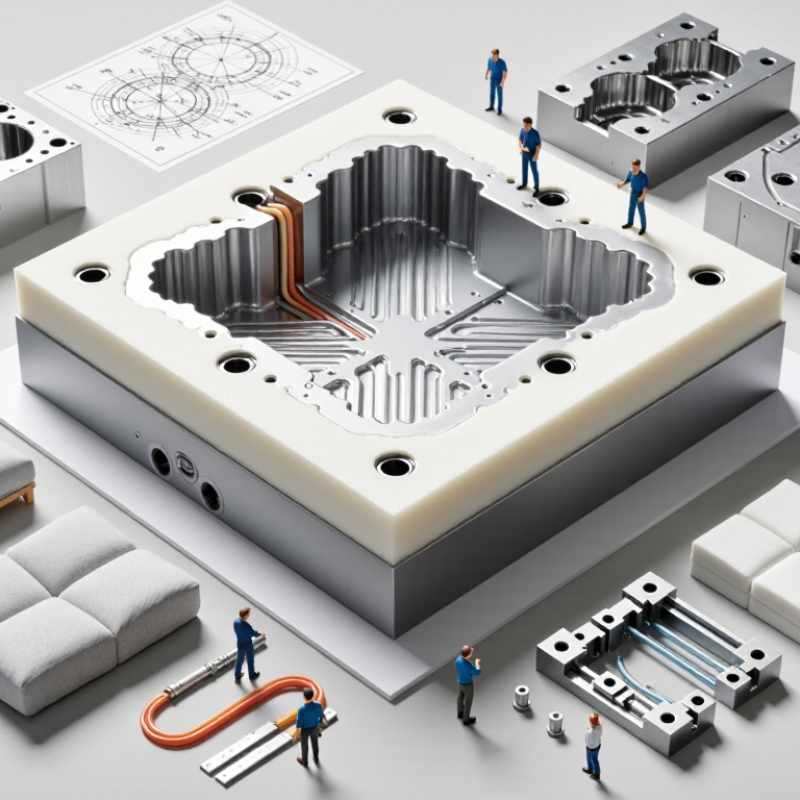
PU Sofa Cushion Foam Moulds: Definition, Purpose, and Main Types
PU sofa cushion foam moulds are shaped tools used to form flexible polyurethane foam into consistent cushion profiles. They control thickness, edges, curves, and support zones during foaming. A well-designed mould also helps the cushion fit its fabric cover without unwanted wrinkles or gaps. In practical production, technicians check foam density, hardness, resilience, and dimensional stability before approving a mould.
The main types include open moulds, closed moulds, contour moulds, and prototype moulds. Open moulds suit small batches and testing because operators can adjust the foam volume easily. Closed moulds support repeatable mass production, with controlled cavity pressure and accurate dimensions. Contour moulds create lumbar curves, sloped seats, or layered comfort zones. Prototype moulds are useful for testing, but they may not reflect final production behavior.
Material choice matters. Aluminum moulds offer lighter handling and faster heat transfer, while steel moulds often provide stronger long-term durability. Vent holes, release systems, and heating channels affect surface quality and curing performance. Poor venting can leave marks or uneven foam density. No mould is perfect. A first trial may reveal compressed corners, inconsistent firmness, or a cover that fits too tightly. Experienced suppliers record these results, revise the cavity, and test again. Buyers should request measured data, sample approval, and clear quality records rather than relying only on catalogue claims.
| Foam Mould Type | Definition | Primary Purpose | Typical PU Foam Characteristics | Common Sofa Cushion Applications | Main Advantages | Key Design Considerations | Supplier Capability to Check |
|---|---|---|---|---|---|---|---|
| Open Mould | A mould with an open top that allows polyurethane foam to rise freely during the foaming process. | Producing simple foam blocks, slab-like cushions, and components that will be cut or trimmed after moulding. | Flexible foam Medium to high resilience Variable density | Loose sofa seat pads, back cushions, cut-to-size inserts, and large cushion blanks. | Lower tooling complexity, easy access for demoulding, and flexible production for different cushion sizes. | Foam rise, free expansion, surface skin formation, trimming allowance, and dimensional stability must be controlled. | Ability to control foam rise, provide consistent block dimensions, and support post-mould cutting operations. |
| Closed Mould | A fully enclosed mould that constrains the foam during chemical reaction and expansion. | Manufacturing cushions with controlled external dimensions, repeatable contours, and integrated surface details. | Moulded flexible foam Consistent shape Controlled density distribution | Contoured seat cushions, shaped backrests, automotive-style seating, and high-volume furniture components. | Good repeatability, reduced trimming, accurate profiles, and improved integration of features such as recesses or channels. | Vent placement, release angle, filling pattern, clamping force, parting line, and internal pressure management. | Experience with mould venting, process simulation, dimensional inspection, and repeatable cycle control. |
| Contour Mould | A mould engineered with curved cavities and ergonomic profiles to form a shaped cushion surface. | Creating cushions that follow the body profile and provide targeted seating comfort or visual styling. | Ergonomic profile Variable thickness Flexible PU foam | Curved sofa seats, waterfall-front cushions, lumbar-support cushions, and designer furniture seating. | Improved comfort, reduced need for manual shaping, and consistent three-dimensional appearance. | Curve radii, foam rebound, local thickness, fabric cover allowance, and prevention of thin-area defects. | Capability to interpret CAD data, build accurate curved cavities, and verify comfort-related geometry. |
| Multi-Cavity Mould | A single mould containing two or more cavities for producing multiple foam parts in one production cycle. | Increasing output and maintaining consistent dimensions across repeated cushion components. | High-volume production Repeatable parts Matched components | Matched seat sets, sofa back cushions, modular furniture cushions, and standardized product ranges. | Higher productivity, reduced cycle cost per part, and improved consistency between components. | Cavity balance, uniform material distribution, synchronized filling, cleaning access, and maintenance time. | Evidence of balanced cavity design, production-capacity planning, and quality checks for cavity-to-cavity variation. |
| Replaceable-Insert Mould | A base mould fitted with interchangeable inserts that modify the cavity shape or surface pattern. | Producing related cushion models without manufacturing a completely new mould for every variation. | Flexible product range Modular tooling Shorter changeover | Furniture collections with different widths, stitching channels, logos, piping grooves, or comfort profiles. | Reduced tooling investment, easier product updates, and practical support for small and medium production runs. | Insert alignment, sealing, wear resistance, interchangeability, and dimensional repeatability after replacement. | Precision machining, documented insert tolerances, spare-part availability, and clear changeover procedures. |
| Aluminium Production Mould | A durable metal mould, commonly machined or cast from aluminium, used for repeated industrial production. | Providing a stable cavity for continuous or large-batch manufacture of moulded PU cushions. | High dimensional stability Good thermal response Production tooling | Commercial sofas, contract furniture, hospitality seating, and long-running cushion programmes. | Good heat transfer, durability, accurate machining, and suitability for repeated production cycles. | Wall thickness, thermal expansion, surface finish, corrosion protection, lifting points, and repairability. | Material certification, machining accuracy, surface-finishing standards, and documented mould-life expectations. |
| Epoxy or Composite Prototype Mould | A mould made from an epoxy or reinforced composite system for development, sampling, or limited production. | Validating cushion geometry, testing fit, and producing early samples before investing in production tooling. | Prototype use Short-run suitability Fast design validation | New sofa concepts, custom furniture, trial cushions, and pre-production ergonomic testing. | Lower initial cost, faster development, and convenient modification during design iteration. | Heat resistance, surface wear, release-system compatibility, dimensional change, and limited service life. | Rapid prototyping, CAD-to-mould workflow, sample approval, and a clear transition plan to production tooling. |
| Vacuum-Assisted Mould | A mould system that uses controlled vacuum or air evacuation to improve filling, venting, or surface formation. | Reducing trapped air and supporting more uniform mould filling in complex cushion geometries. | Complex profiles Improved venting Surface consistency | Deep-contour cushions, detailed moulded surfaces, and designs where air entrapment may cause visible defects. | Better cavity filling, fewer void-related defects, and improved consistency in difficult shapes. | Vacuum port layout, seal integrity, suction level, cleaning, cycle timing, and compatibility with the foam system. | Process-control experience, vacuum-system maintenance, trial documentation, and defect-reduction records. |
| Temperature-Controlled Mould | A mould equipped with heating or cooling provisions to manage the thermal conditions of the foaming reaction. | Improving cure consistency, cycle stability, and dimensional control for demanding foam formulations. | Stable curing Repeatable cycles Process-sensitive foam | High-volume moulded cushions, thick-section parts, and products requiring tight process consistency. | More stable production conditions, improved surface quality, and better repeatability across shifts. | Temperature uniformity, sensor placement, heating or cooling channels, energy use, and safe operating limits. | Thermal mapping, controller calibration, process data logging, and preventive-maintenance support. |
| Textured-Surface Mould | A mould whose cavity includes a patterned or textured finish that transfers a surface effect to the foam part. | Creating decorative, functional, or bonding-related surface features without additional machining. | Surface pattern Enhanced appearance Optional grip texture | Decorative sofa cushions, anti-slip underside profiles, structured upholstery components, and design-led furniture. | Repeatable visual effects and reduced reliance on secondary surface-processing steps. | Texture depth, release performance, cleaning, wear resistance, and compatibility with upholstery covers or adhesives. | Surface-finishing quality, texture replication accuracy, release-agent control, and sample approval procedures. |

We have over 30 years of experience in designing complete hydraulic systems, repairs and distribution of fluid power equipment and parts.
FOLLOW US ON :
Contact Details
Address:
4020 SE 45th CT.
Ocala, FL 34480
Phone No:
Email:
sales@cunninghamfluidpower.com